Upcoming Workshop: Citizen Developer Agentic Software Factory on AWS
Register Here!
Disposable Environments: The Missing Piece for AI Infrastructure Agents
AI agents need real infrastructure to test against. Not plans. Not mocks. We are building disposable, isolated environments where agents do the labor and humans make the call.
terraform plan Is Not Validation
It’s a diff. A prediction. A machine telling you what it intends to do; not proof that the result will work. Many have convinced themselves that reviewing a plan is the same thing as testing infrastructure. It isn’t.
I've been writing Terraform for the better part of a decade. I've reviewed thousands of plans. And I still get that little pit in my stomach every time I see Plan: 47 to add, 3 to change, 2 to destroy. Because a plan is a promise made by a machine that has never actually tried the thing it's promising.
A plan tells you the syntax is correct. It tells you the provider thinks it can do the thing. It tells you nothing about whether the IAM policy actually grants the permissions your app needs. It tells you nothing about whether the security group rules play nice with your VPC's CIDR blocks. It tells you nothing about whether the RDS parameter group is compatible with your connection pooler.
Every AI infrastructure tool today ends the same way: the agent generates some IaC, runs terraform plan, and says "looks good." Maybe it passes a linter. Maybe it even checks a policy engine. Then a human is supposed to review the output and decide whether to ship it.
That's a guess with syntax highlighting.
Real validation requires real infrastructure. You need to actually deploy the thing, run compliance against it, and see if it works. You've always known this. You just haven't had a safe place to do it.
Where Does the Agent Work?
You can't let an AI agent deploy to production. Obviously.
You can't let it deploy to staging either. Break staging and suddenly the whole engineering org is blocked.
So you spin up a "dev" environment. And then the agent deploys something that conflicts with what another agent deployed ten minutes ago. Or it corrupts state because two processes are running terraform apply against the same state file. Or it works in dev because dev has a different VPC layout than prod, and you find out the hard way when a human finally pushes to staging.
We've been building infrastructure tooling for years. We've seen every version of this problem. And the answer we kept arriving at was: give each agent its own disposable copy of production.
The Pattern: Clone, Test, Hand Off, Destroy
Here's the workflow we're building:
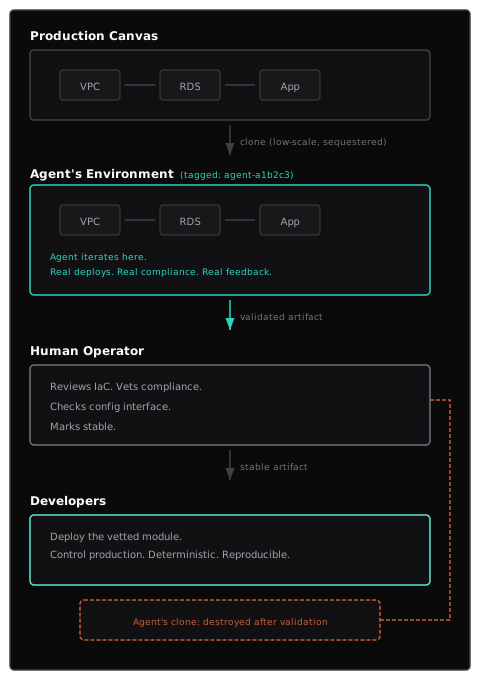
A real, low-scale clone of your production architecture. Same topology. Same bundles. Same connections. Fraction of the scale. Provisioned into an isolated cloud account with its own IAM boundaries. The agent deploys into it, iterates against real compliance checks, gets real feedback from real infrastructure. When it's done, it hands the validated artifact to a human.
The agent never touches production. The agent doesn't even know production's credentials exist.
An agent picks up a task. Say, upgrading your PostgreSQL bundle to support a new extension.
The agent clones your production canvas. A new environment spins up, tagged with the agent's unique ID. Same architecture, t3.small instances instead of m5.xlarge. Single-node databases instead of multi-AZ. Provisioned into a sequestered AWS account where the agent's credentials can't reach anything else.
The agent iterates. It modifies the IaC, publishes a development release, deploys into its cloned environment. Real resources. Real compliance scans. The compliance check fails because the new extension requires a parameter that violates your CIS benchmark policy. The agent sees the actual finding. Fixes it. Redeploys. Compliance passes.
This is the part that matters. The agent didn't get a theoretical "this might fail." It failed. The agent saw why. The agent fixed it. That's validation.
The agent reports back. "I tested upgrading your PostgreSQL bundle from v2.3.1 to v2.4.0 in an isolated environment. Compliance passed. No regressions. Here's the deployment log, the compliance report, and the artifact."
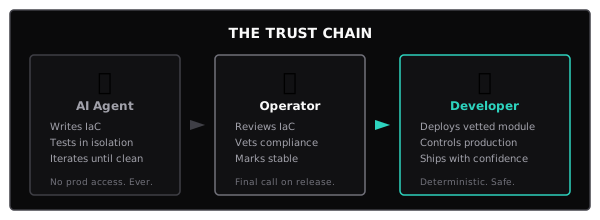
A human decides. The operator reviews the actual infrastructure module. Is the IaC compliant? Does the configuration interface make sense for the developers who will interact with it? Are the parameters clear? Are the defaults sane? Are the guardrails appropriate?
If it meets the bar, the human marks it stable.
Developers execute. Once stable, developers have a vetted infrastructure module they can diagram and deploy themselves without learning your DevOps team's tooling. They control production. Safely. Deterministically. The same artifact the agent built and the operator approved. No pipelines. No re-generation. No variance. No hoping the AI produces the same thing twice.
The clone gets torn down. Resources destroyed. Cloud account recycled.
The Architecture Is the Notebook
Tearing down the infrastructure doesn't mean tearing down the environment definition. An agent can destroy all the running resources in its cloned environment. Stop the meter. Zero the cost. The canvas architecture stays intact. The topology, the deployment history, the compliance results, the agent's notes about what it tried and what failed.
Why does this matter? Long-running campaigns.
If an agent is working through a major version migration, v2.3 to v3.0 of a database bundle, it might take multiple sessions across days or weeks. Between sessions, the agent tears down the running infrastructure. You're not paying for idle resources. When it picks back up, it re-provisions from the same canvas and continues where it left off. Full context of its previous attempts.
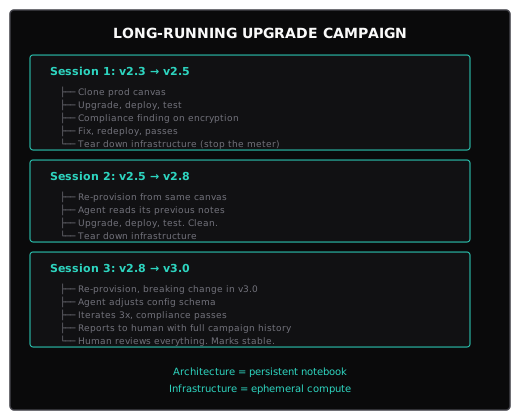
The architecture is the notebook. The infrastructure is ephemeral. You pay for compute only when the agent is actively working.
Proactive, Not Reactive
Day-two is endless. You shipped on Monday. Six months later, it's still Monday. Patching. Upgrading. Rotating credentials. Chasing compliance findings. Promising you’d "clean that up next sprint."
Day two isn't a phase, its a treadmill.
Disposable environments change that.
Day two stops being reactive work sitting in a backlog. It becomes something that runs continuously in the background, and it's validated against real infrastructure, not deferred behind feature work.
An agent with access to disposable production clones doesn’t wait for a ticket.
It can:
- Clone production.
- Upgrade every bundle to the latest version.
- Deploy into isolated environments.
- Run compliance and regression checks.
- Tear everything down.
Then it reports back: "Three bundles have updates available. Two upgraded cleanly in isolated environments. One triggered a compliance finding. Here’s the report. Here’s the diff. Here’s my proposed fix." (probably with a lot more emoji)
The agent never touched production. It never will.
But it already did the hard part.
Now the operator reviews validated artifacts instead of reviewing guesses. Day-two operations stop being a backlog of "we should upgrade that sometime" and become a steady stream of tested, review-ready improvements.
When was the last time you proactively upgraded a Terraform module because a new version was available? When was the last time you tested that upgrade against a replica of production before shipping it?
Yeah. That's what I thought.
Security as a Hard Boundary
Each cloned environment lives in its own cloud account.
The agent's credentials are scoped to that account. It cannot access production resources. It cannot interfere with another agent's work. It cannot leak credentials across account boundaries.
The blast radius of anything an agent does is exactly one disposable environment. If it does something catastrophically wrong, misconfigures a security group, provisions an open S3 bucket, whatever, it happened in an isolated account that gets destroyed when the work is done.
You're not trusting the agent to be perfect. You're constraining its blast radius to a space where imperfection doesn't matter. And you're putting a human between the agent's output and anything that touches production.
The Economics
A typical production canvas might cost $2,000/month. A low-scale clone, t3.small instances, single-node databases, minimal storage, runs at roughly 5-10% of that.
But the clone doesn't run continuously. An agent session might take 30 minutes to 2 hours. If you're running 20 agent sessions per month, that's around 40 hours of compute out of 720 hours in a month. Real cost: roughly $8-10/month.
Compare that to the cost of a production incident caused by an infrastructure change that was never tested against real infrastructure.
The math isn't close.
There's a Better Way
The infrastructure industry has spent two decades building tools that help humans manage infrastructure faster. AI agents don't need faster tools. They need a fundamentally different operating model. One where they can safely iterate against real infrastructure without ever touching production. One where the agent proves it ... and a human approves it.
Disposable environments are that operating model. The agent does the labor. The human makes the call.
Massdriver's agentic harness is the infrastructure layer that makes this possible—structured context, guardrailed execution, and disposable production clones that give agents real situational awareness without ever reaching production.
Book a call and I will show you the way.