New: LLM Rankings are live!
See how the top LLMs rank on real infrastructure tasks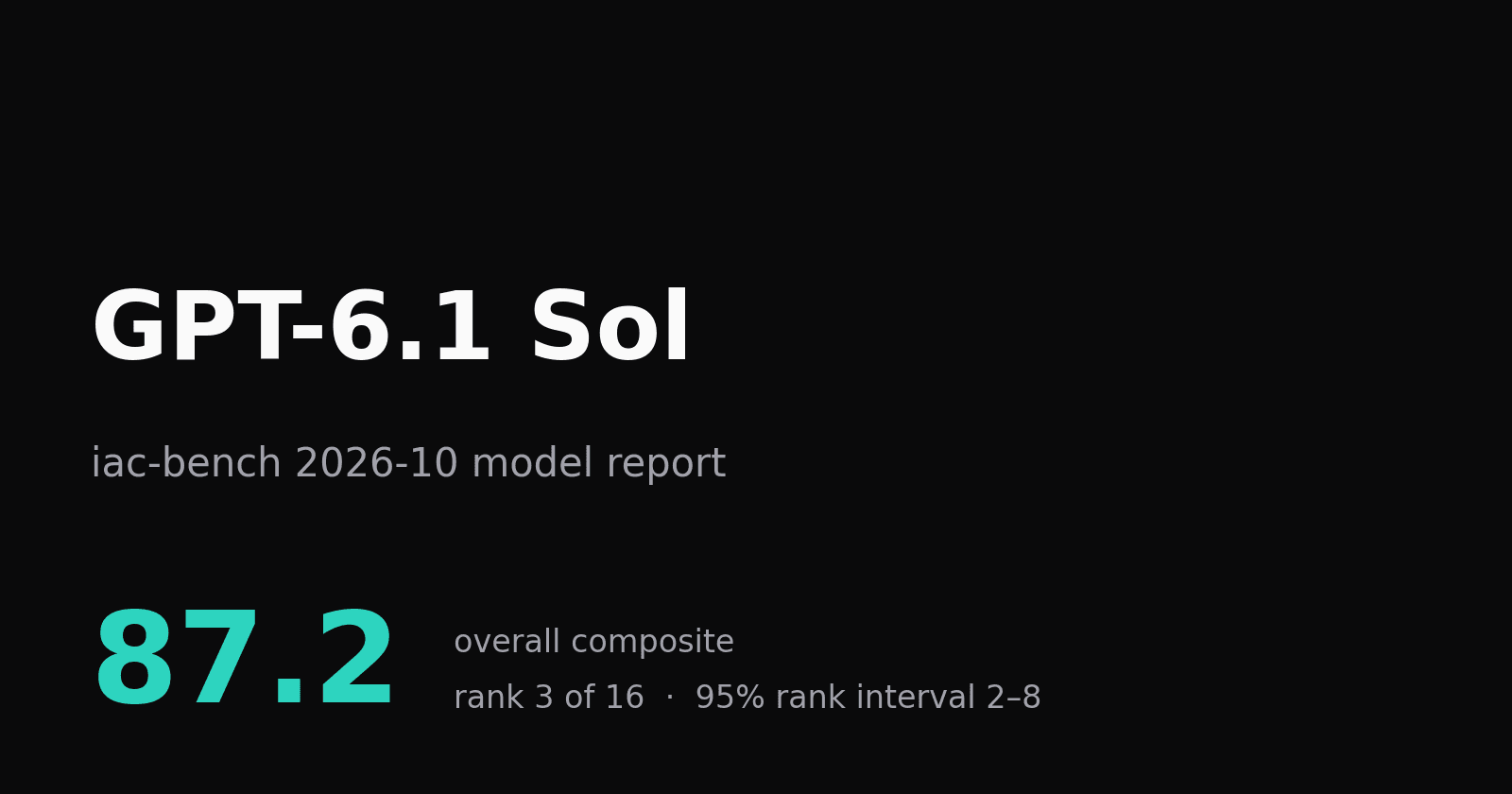
GPT-6.1 Sol on iac-bench 2026-10
How GPT-6.1 Sol did on iac-bench 2026-10: an overall composite of 87.2, scores per fixture, strengths, weaknesses and the patterns in its OpenTofu modules.
Every model evaluated on the 2026-10 fixtures side by side, with a sortable leaderboard, picks by use case and the cost of each: LLM rankings.
| Developer | OpenAI |
| API identifier | gpt-6.1-sol |
| Access | OpenAI API (Responses) |
| Weights | Closed |
| List price (USD / M tokens, in / out) | 2.00 / 10.00 (OpenRouter, 2026-11-10) |
| Evaluated | 2026-11-10 (generation and judge) |
| Attempts | 9 (3 fixtures × 3 samples) |
| Overall composite | 87.2 (95% CI 84.9–92.3) |
| Rank | 3 of 16 (95% rank interval 2–8) |
| Mechanical only / judge only | 83.9 (rank 5) / 94.7 (rank 3) |
| Failed gates · insecure attempts | 0/9 · 0/9 |
| Estimated cost, all 9 attempts | $1.02 |
Summary
GPT-6.1 Sol places third of 16 by composite (87.2) and sits in the second group with Claude Opus 5.5, Claude Fable 5.1, GPT-6 Astra, Kimi K3.1 Pro and Claude Sonnet 5.5, with a 95% rank interval of 2–8. In the bootstrap it finishes ahead of Astra in 49% of resamples, ahead of Fable 5.1 in 54%, ahead of Sonnet in 71% and ahead of Kimi K3.1 Pro in 67%. It is the cheapest model in that group: $1.02 for all 9 attempts, against $1.52 for Sonnet and $7.26 for Astra.
All 9 attempts planned, with no security findings. App Service (G003) is its strongest fixture, third in the field by median composite. S3 (G001) is eleventh.
Scores
| Fixture | Composite median (range) | Rubric median | Expertise | Judge median | ✗ gate | ⚠ security | Median inputs | Median output tokens | Median time | Median cost |
|---|---|---|---|---|---|---|---|---|---|---|
| G001 · S3 | 78.1 (72.8–91.6) | 0.721 | 4/7 | 94.7 | 0/3 | 0/3 | 6 | 4,434 | 129 s | $0.066 |
| G002 · Cloud SQL | 89.3 (87.7–89.3) | 0.875 | 5/9 | 100.0 | 0/3 | 0/3 | 17 | 7,559 | 165 s | $0.110 |
| G003 · App Service | 94.1 (94.1–95.9) | 0.972 | 4/5 | 89.5 | 0/3 | 0/3 | 17 | 10,013 | 379 s | $0.168 |
Rubric items not at full credit, counted over attempts that planned: G001: A5 1/3, B1 2/3, H6 2/3, H7 2/3, H9 2/3, H12 3/3, H13 3/3, H14 1/3, H15 1/3; G002: B1 3/3, H4 3/3, H5 3/3, H11 3/3; G003: B2 2/3. Definitions are in Scoring criteria.
Strengths
- Security posture fixed in code in all 9 modules. On Cloud SQL this includes
connector_enforcement = "REQUIRED"and validation that rejects overrides of IAM authentication. On App Service, both basic-auth publishing flags are off on the app and the slot; Claude Sonnet 5.5 leaves them on in 2/3 (H2). - Login grants for IAM users (3/3). Every Cloud SQL attempt grants both
cloudsql.clientandcloudsql.instanceUser(E6), the grant GPT-6 Luna omits. - Managed-identity image pulls (3/3, E4).
AcrPullgoes to the identities the app and the staging slot pull with, where GPT-6 Luna uses registry passwords. - Smaller interfaces than Claude Sonnet 5.5: median 6, 17 and 17 inputs against 10, 26
and 27. It stays within the App Service budget (
A7), which Sonnet exceeds in 3/3.
Weaknesses
- S3 retention and logging:
- no bucket policy admits the logging service (
H13, 3/3); - access logging offered in one attempt only (
H9lost 2/3); - expiration and noncurrent-version rules in one attempt only (
H6,H7lost 2/3). The other two expire only incomplete multipart uploads.
- no bucket policy admits the logging service (
- Databases dropped on removal (
H11, 3/3). Nogoogle_sql_databasesetsdeletion_policy. Backups and point-in-time recovery cannot be turned off (H4/H5at 0.75 in 3/3). - Provider constraints that admit a new major in 5 of 9 attempts (
B1), including>= 6.0, < 8.0in all three Cloud SQL modules. - Raw CORS on S3.
cors_rulesmirrors the provider'scors_ruleblock. Interface design 1 in 6 of 9 S3 readings, each citing it. - Duplicate registry inputs on App Service, as with GPT-6 Astra: an ACR resource ID and
a
registry_urlthat can disagree. Data sources vs inputs 1 in 8 of 9 readings. - A latent type error in G002 e3:
iam_principalspassesIAM_USER-style values togoogle_sql_user.type, which expectsCLOUD_IAM_USER. The judge caught it (Variables and validation 1). The rubric did not, because the sweep does not populate collection inputs.
Characteristic patterns
- Optional features behind object-typed inputs. Every App Service attempt turns zone
balancing on through attributes of a
capacityobject, and the S3 e3 attempt enables access logging when anaccess_loggingobject is supplied. The rubric credits both (H73/3,H9in e3). - A TLS-deny statement that exempts AWS service principals in 3/3 S3 attempts (excerpt below).
- Slot warm-up wiring. Two App Service attempts point
WEBSITE_SWAP_WARMUP_PING_PATHat the health-check path, so a swap waits for the staging slot to respond.
Representative excerpt
G001/gpt-6.1-sol-e1/main.tf lines 63–75
    Statement = [{
      Sid       = "DenyInsecureTransport"
      Effect    = "Deny"
      Principal = "*"
      Action    = "s3:*"
      Resource  = [aws_s3_bucket.assets.arn, "${aws_s3_bucket.assets.arn}/*"]
      Condition = {
        Bool = {
          "aws:SecureTransport"       = "false"
          "aws:PrincipalIsAWSService" = "false"
        }
      }
    }]
The TLS-deny statement carries a second condition that exempts AWS service principals, with the comment "Exempt direct AWS service principals as their network context can be redacted." It appears in all three S3 attempts and in no other model's modules.