New: LLM Rankings are live!
See how the top LLMs rank on real infrastructure tasks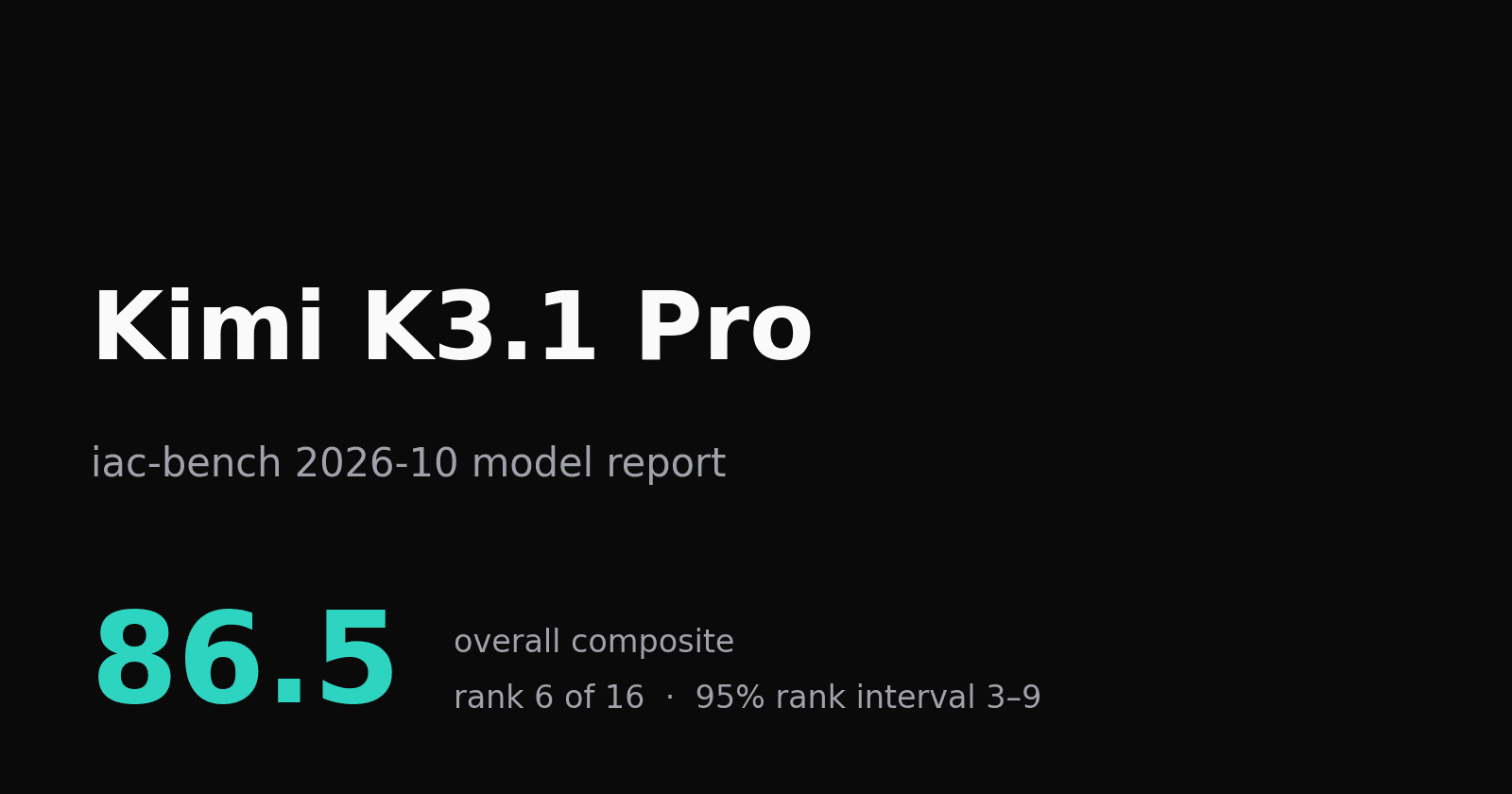
Kimi K3.1 Pro on iac-bench 2026-10
How Kimi K3.1 Pro did on iac-bench 2026-10: an overall composite of 86.5, scores per fixture, strengths, weaknesses and the patterns in its OpenTofu modules.
Every model evaluated on the 2026-10 fixtures side by side, with a sortable leaderboard, picks by use case and the cost of each: LLM rankings.
| Developer | Moonshot AI |
| API identifier | moonshotai/kimi-k3.1-pro |
| Access | OpenRouter, pinned to Moonshot AI's endpoint (MXFP4) |
| Weights | Open |
| List price (USD / M tokens, in / out) | 2.00 / 10.00 (OpenRouter, 2026-11-10) |
| Evaluated | 2026-11-10 (generation and judge) |
| Attempts | 9 (3 fixtures × 3 samples) |
| Overall composite | 86.5 (95% CI 84.8–88.7) |
| Rank | 6 of 16 (95% rank interval 3–9) |
| Mechanical only / judge only | 85.6 (rank 3) / 88.6 (rank 9) |
| Failed gates · insecure attempts | 0/9 · 0/9 |
| Estimated cost, all 9 attempts | $3.52 |
Summary
Kimi K3.1 Pro places sixth of 16 by composite (86.5), the highest open-weight model, with a 95% rank interval of 3–9. It is third on the mechanical score alone (85.6, behind Claude Fable 5.2 and Claude Opus 5.5) and ninth on the judge score (88.6). In the bootstrap it finishes ahead of Claude Sonnet 5.5 in 54% of resamples, ahead of Claude Fable 5.1 in 35%, GPT-6.1 Sol in 33% and GPT-6 Astra in 27%, and ahead of Kimi K3 in more than 99%. All 9 attempts cost $3.52, about the same as Claude Opus 5.5 ($3.58), against $1.52 for Sonnet, $1.02 for Sol and $3.96 for Kimi K3.
All 9 attempts planned, with no security findings. Kimi K3 had four findings and one failed gate. S3 (G001) is its strongest fixture, tied fourth in the field by median composite (85.6, with Claude Fable 5.1). App Service (G003) has its highest median (87.8) but places eighth, and Cloud SQL (G002) places seventh (86.0, up from 79.2 for Kimi K3).
Scores
| Fixture | Composite median (range) | Rubric median | Expertise | Judge median | ✗ gate | ⚠ security | Median inputs | Median output tokens | Median time | Median cost |
|---|---|---|---|---|---|---|---|---|---|---|
| G001 · S3 | 85.6 (84.0–86.4) | 0.849 | 4/7 | 92.1 | 0/3 | 0/3 | 12 | 12,640 | 526 s | $0.174 |
| G002 · Cloud SQL | 86.0 (84.2–91.8) | 0.875 | 7/9 | 86.8 | 0/3 | 0/3 | 24 | 19,216 | 720 s | $0.300 |
| G003 · App Service | 87.8 (84.7–87.8) | 0.889 | 4/5 | 86.8 | 0/3 | 0/3 | 51 | 42,983 | 1866 s | $0.669 |
Rubric items not at full credit, counted over attempts that planned: G001: A5 3/3, H12 3/3, H13 3/3, H15 3/3; G002: A8 1/3, B1 3/3, H4 3/3, H5 3/3, H9 1/3, H11 2/3; G003: A7 3/3. Definitions are in Scoring criteria.
Strengths
- The Cloud SQL security gap of Kimi K3 is closed.
ssl_mode = "ENCRYPTED_ONLY"is a literal in 3/3 attempts, next toipv4_enabled = false(H2passes 3/3; Kimi K3 failed it 3/3 by validating an input that admitted unencrypted connections). No S3 attempt offers public reads (H1, which Kimi K3 lost in 1/3). - Connection auditing and forced IAM login. Every Cloud SQL module merges consumer
flags into a baseline and then re-applies
cloudsql.iam_authentication = "on"last, so it cannot be overridden.log_connectionsandlog_disconnectionsare on in 3/3 (E8, which Kimi K3 misses in 3/3). - Hardcoded App Service posture on the app and the slot. Both basic-auth publishing
flags off, HTTPS-only and TLS 1.2 in 3/3, and every attempt plans: the staging slot sets
health_check_eviction_time_in_min, the pairing that failed Kimi K3's gate. Autoscale,WEBSITES_PORT, metric alerts andAcrPull(E1–E4) appear in 3/3; Key Vault references (E5) in none. - Tighter provider constraints.
B1is lost in 3 of 9 attempts, all on Cloud SQL, against 6 of 9 for Kimi K3 and Claude Fable 5.1 and 5 of 9 for GPT-6.1 Sol.
Weaknesses
- The largest App Service interfaces in the field: 50, 51 and 54 inputs against a budget
of 20, so
A7scores zero in 3/3. Kimi K3 used 20–34, and the next-largest median is Gemini 3.6 Flash at 40. Many are attribute pass-throughs (ip_restrictions,vnet_route_all_enabled,container_start_time_limit). Interface design 1 in 6 of 9 readings. - Duplicate and conflicting registry inputs.
container_registry_idbesidecontainer_registry_urlin 3/3, and a managed identity's client ID beside its principal ID in e2. A registry password is accepted as an alternative toAcrPullin 3/3. Data sources vs inputs 1 in 8 of 9 readings, Sensitive values 1 in 6. - Cloud SQL regressions against Kimi K3:
- service-account users keep the
.gserviceaccount.comsuffix, which Cloud SQL rejects, in 3/3 (Kimi K3 trims it in 3/3). The e1 and e3 READMEs document the full email as the username: Documentation 0 in 5 of 9 readings; - backups and point-in-time recovery are always on with no opt-out (
H4/H5at 0.75, 3/3), where Kimi K3 offered one; - a customer-managed key can be supplied in 1/3 (E2), against 3/3 for Kimi K3.
- service-account users keep the
- Carried over from Kimi K3: transaction-log retention capped at 7 days in 3/3 while
ENTERPRISE_PLUS(35 days) is offered; Cloud SQL provider ranges such as>= 5.20.0, < 7.0.0that span two majors; no AWS provider block (H15, 3/3); S3 over budget with 12–13 inputs (A5, 3/3). - Databases dropped on removal (
H11lost 2/3). e1 and e3 set nodeletion_policy. e2 defaults it toABANDONthrough anoptional()attribute of thedatabasesmap, which earns full credit. - S3 logging that cannot deliver (
H13, 3/3). e1 and e3 write to a caller-supplied bucket. e2 creates its own log bucket, but the policy grantslogging.amazonaws.cominstead oflogging.s3.amazonaws.com(excerpt below).
Characteristic patterns
- Fewer tokens, longer runs. 233k output tokens across 9 attempts against 316k for Kimi K3, yet a median of 31 minutes per App Service attempt, second only to GLM-5.3. It was served through OpenRouter pinned to Moonshot AI's own endpoint; Kimi K3 was routed without a pinned host, so timings are not directly comparable.
- Identity-first Cloud SQL, as in Kimi K3: private IP only, IAM database login, workload
identities and Query Insights in 3/3. e2 also grants
cloudsql.instanceUserandcloudsql.clientto each IAM user (E6), which Kimi K3 never does. Validation stays as dense as Kimi K3's: 20–21 blocks per Cloud SQL module, 22–28 per App Service module.
Representative excerpt
G001/kimi-k3.1-pro-e2/main.tf lines 254–270
  statement {
    sid    = "AllowServerAccessLogDelivery"
    effect = "Allow"

    principals {
      type        = "Service"
      identifiers = ["logging.amazonaws.com"]
    }

    actions   = ["s3:PutObject"]
    resources = ["${aws_s3_bucket.logs[0].arn}/access-logs/*"]

    condition {
      test     = "ArnLike"
      variable = "aws:SourceArn"
      values   = [aws_s3_bucket.this.arn]
    }
The one S3 attempt that creates its own log bucket also writes a delivery grant for it, scoped to this bucket's ARN, but names the service principal logging.amazonaws.com. S3 server access logs are delivered by logging.s3.amazonaws.com, so the statement admits nothing and the rubric's delivery check (H13) fails.