New: LLM Rankings are live!
See how the top LLMs rank on real infrastructure tasks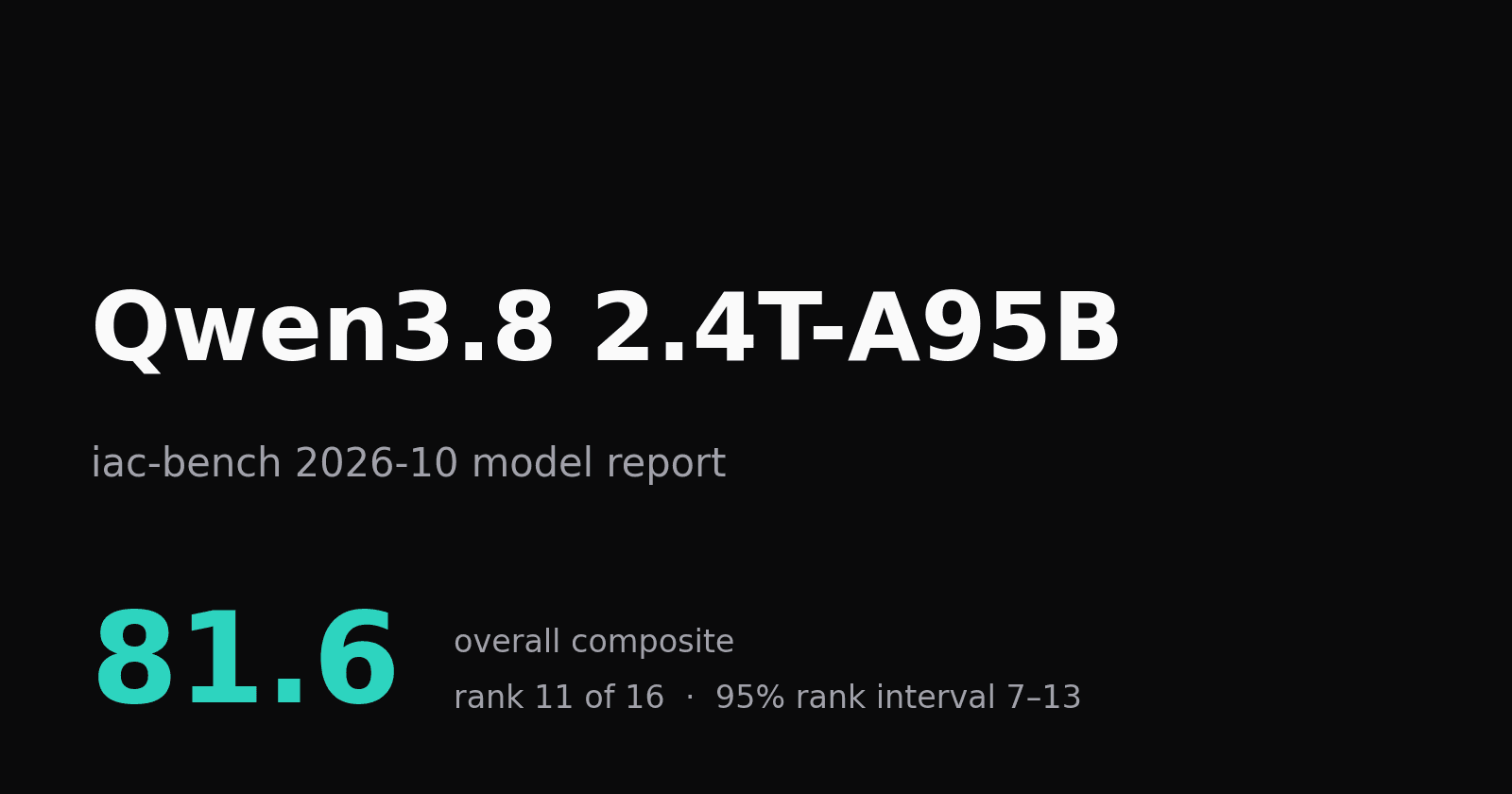
Qwen3.8 2.4T-A95B on iac-bench 2026-10
How Qwen3.8 2.4T-A95B did on iac-bench 2026-10: an overall composite of 81.6, scores per fixture, strengths, weaknesses and the patterns in its OpenTofu modules.
Every model evaluated on the 2026-10 fixtures side by side, with a sortable leaderboard, picks by use case and the cost of each: LLM rankings.
| Developer | Alibaba |
| API identifier | qwen/qwen3.8-2.4t-a95b |
| Access | OpenRouter, pinned to Alibaba's endpoint |
| Weights | Open |
| List price (USD / M tokens, in / out) | 2.00 / 6.00 (OpenRouter, 2026-11-10) |
| Evaluated | 2026-11-10 (generation and judge) |
| Attempts | 9 (3 fixtures × 3 samples) |
| Overall composite | 81.6 (95% CI 71.7–86.2) |
| Rank | 11 of 16 (95% rank interval 7–13) |
| Mechanical only / judge only | 78.6 (rank 12) / 86.8 (rank 11) |
| Failed gates · insecure attempts | 0/9 · 4/9 |
| Estimated cost, all 9 attempts | $4.41 |
Summary
Qwen3.8 2.4T-A95B places eleventh of 16 by composite (81.6), between GLM-5.3 (82.5) and GPT-6 Luna (81.5), with a 95% rank interval of 7–13. Against its neighbours the bootstrap is close to a coin flip: it finishes ahead of Kimi K3 in 48% of resamples, GPT-6 Luna in 45% and GLM-5.3 in 43%, and ahead of Kimi K3.1 Pro in 2%. All 9 attempts cost $4.40, against $3.52 for Kimi K3.1 Pro, $3.96 for Kimi K3, $8.46 for GLM-5.3 and $0.88 for DeepSeek V4 Pro.
All 9 attempts planned. 4 of 9 carry a security finding: one on S3 and three on App Service. Cloud SQL (G002) is its strongest fixture, fifth in the field by median composite (89.0) and the highest of the open-weight models. App Service (G003) is its weakest, thirteenth (71.7).
Scores
| Fixture | Composite median (range) | Rubric median | Expertise | Judge median | ✗ gate | ⚠ security | Median inputs | Median output tokens | Median time | Median cost |
|---|---|---|---|---|---|---|---|---|---|---|
| G001 · S3 | 84.1 (66.8–91.0) | 0.791 | 6/7 | 94.7 | 0/3 | 1/3 (H1) | 9 | 27,441 | 766 s | $0.326 |
| G002 · Cloud SQL | 89.0 (85.3–89.6) | 0.897 | 5/9 | 89.5 | 0/3 | 0/3 | 20 | 37,210 | 1055 s | $0.434 |
| G003 · App Service | 71.7 (59.4–78.7) | 0.706 | 3/5 | 76.3 | 0/3 | 3/3 (H1, H2) | 29 | 42,862 | 1383 s | $0.523 |
Rubric items not at full credit, counted over attempts that planned: G001: A5 2/3, B1 3/3, H1 1/3, H9 2/3, H12 3/3, H13 3/3, H15 2/3; G002: A4 1/3, B1 2/3, H4 3/3, H5 3/3, H11 2/3; G003: A6 1/3, A7 3/3, H1 2/3, H2 2/3, H3 1/3, H4 1/3. Definitions are in Scoring criteria.
Strengths
- Cloud SQL posture fixed in code (3/3).
ipv4_enabled = falseandssl_mode = "ENCRYPTED_ONLY"are literals, where Kimi K3 letsssl_modebe weakened in 3/3. The private network is derived fromenvironment(apps-<environment>). - Identity-only database access. IAM database login (E3), declared users (E5) and
workload identities (E7) in 3/3, with no password users. One attempt merges
cloudsql.iam_authentication,log_connectionsandlog_disconnectionsover the DBA's flags, rejects any input that sets them, and refuses to disable deletion protection inprod. - S3 expertise. 6 of 7 expertise items in 3/3, including bucket-owner-enforced ownership (E1), a TLS-deny policy (E4) and ready-to-attach consumer policies (E9). S3 judge median 94.7.
- Every module plans (9/9), where Kimi K3 and GLM-5.3 each fail one App Service attempt.
Autoscale rules (E1), the container port (E2) and a staging slot (
H9) appear in 3/3.
Weaknesses
- Security findings:
H1on S3 (e1); on App ServiceH2(e1),H1andH2(e2),H1(e3). Kimi K3.1 Pro has none. The cause is under Characteristic patterns. - Documentation that contradicts the code (Documentation 0 in 5 of 9 attempts; only
DeepSeek V4 Pro has more, 6/9):
- every App Service README describes deploying a new image to the staging slot and then swapping, but one image input feeds both the production app and the slot (3/3);
- Cloud SQL descriptions ask for full service-account emails, which become
google_sql_usernames that PostgreSQL rejects until the.gserviceaccount.comsuffix is trimmed (3/3). The judge caught it; the rubric did not.
- Large App Service interfaces: 27, 29 and 41 inputs against a budget of 20 (
A7partial or zero, 3/3). The 41-input attempt also exposeshttp2_enabled(A6). - Gaps on S3 and Cloud SQL:
- no bucket policy admits the logging service (
H13, 3/3); logging (H9) and a provider block with a region input (H15) each appear in 1/3; - backups and point-in-time recovery cannot be turned off (
H4/H5at 0.75, 3/3), and backups never outlive the instance (E1, 0/3); - no
deletion_policyin either attempt that declares databases (H11).
- no bucket policy admits the logging service (
- Provider constraints that admit a new major in 5 of 9 attempts (
B1):>= 5.0or>= 6.0on S3 (3/3), and>= 5.30.0, < 7.0.0spanning two majors on Cloud SQL (2/3).
Characteristic patterns
-
Wide spread within a fixture. Mechanical scores run 0.57–0.87 on S3 and 0.53–0.80 on App Service, against a spread of 0.05 on Cloud SQL, all from modules that plan. Each sample hardcodes a different subset of the security posture and exposes the rest:
- S3 e1 adds
allow_public_access, which turns off all four public-access-block settings (H1, 18 of 86 rubric weight). The other two S3 attempts keep them fixed; - App Service e1 hardcodes HTTPS-only, TLS 1.2 and FTP off, but never sets the basic-auth
publishing flags, which default to on (
H2); - e3 turns basic auth off and hardcodes TLS 1.2, then exposes
https_onlyand the managed identity as inputs (H1,H4; excerpt below); - e2 sets neither basic-auth flag, leaves
https_onlyoff the slot, and exposesminimum_tls_versionandftps_statewith validations that accept"1.0"and"AllAllowed"(H1,H2,H3).
Kimi K3.1 Pro varies by at most 0.075 on any fixture. Kimi K3 and GLM-5.3 have wider App Service spreads, but theirs come from a failed plan.
- S3 e1 adds
-
Long transcripts. Median 37,210 output tokens per attempt, second in the field after GLM-5.3. The longest (App Service e2: 68,729 tokens, $1.02, 41 inputs) is also its lowest-scoring attempt (59.4).
Representative excerpt
G003/qwen3.8-2.4t-a95b-e3/main.tf lines 48–67
  https_only                    = var.https_only
  public_network_access_enabled = var.public_network_access_enabled
  virtual_network_subnet_id     = var.virtual_network_subnet_id

  # HTTP APIs are stateless; session affinity only pins users to instances
  # that may be recycled, so keep it off.
  client_affinity_enabled = false

  # Images arrive from a container registry, never over password-based
  # publishing endpoints.
  ftp_publish_basic_authentication_enabled       = false
  webdeploy_publish_basic_authentication_enabled = false

  dynamic "identity" {
    for_each = var.managed_identity_enabled ? ["SystemAssigned"] : []

    content {
      type = identity.value
    }
  }
One App Service resource, two postures. Basic-auth publishing is hardcoded off with a comment explaining why, while HTTPS-only and the managed identity are left to inputs (https_only, managed_identity_enabled). Both default to the secure setting, but either can be switched off, which costs this attempt H1 and H4. Each App Service sample draws this line in a different place.