Upcoming Workshop: Citizen Developer Agentic Software Factory on AWS 11.4.26 @ 12PM PST
Register Here!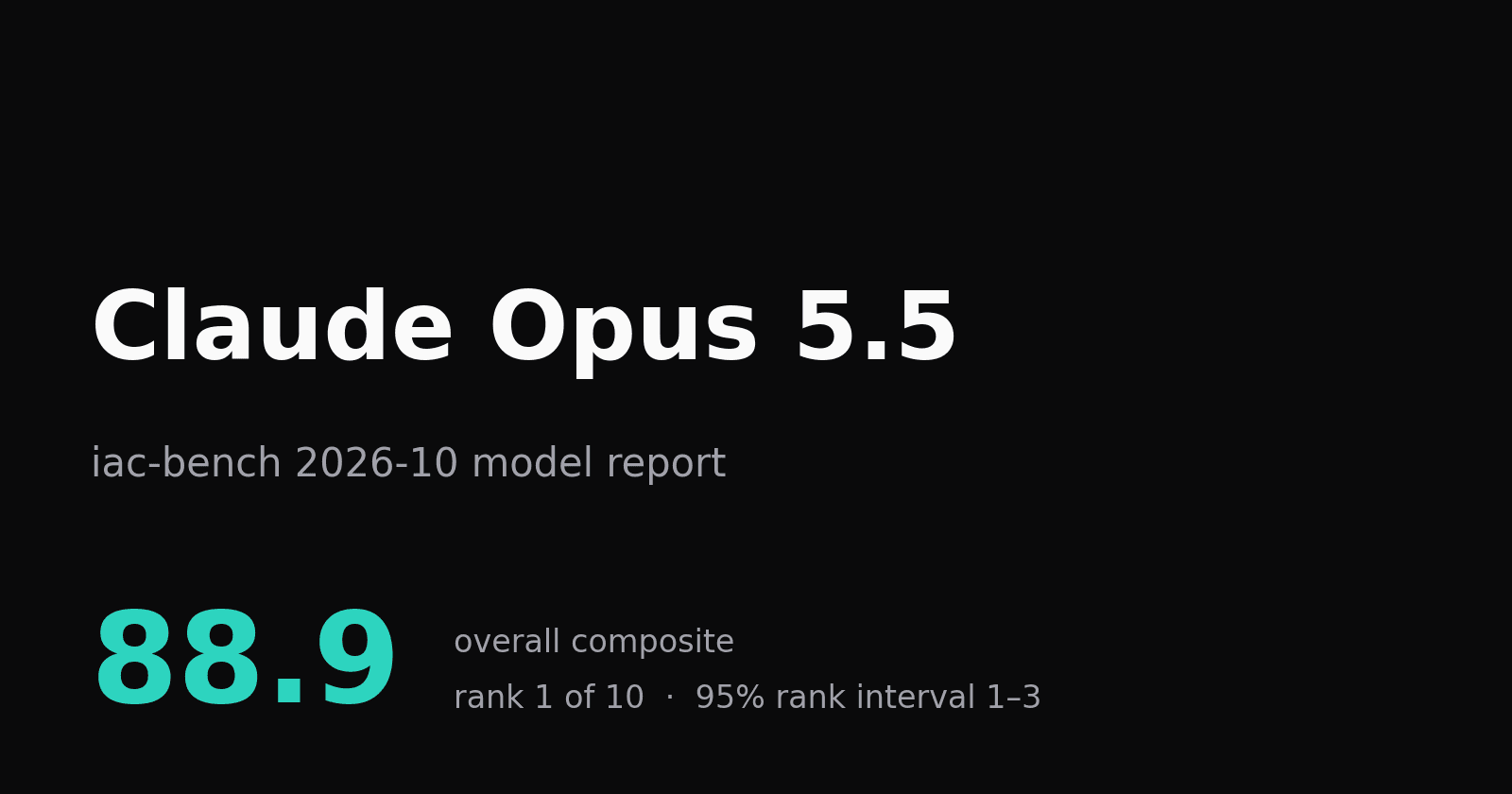
Claude Opus 5.5 on iac-bench 2026-10
How Claude Opus 5.5 did on iac-bench 2026-10: an overall composite of 88.9, scores per fixture, strengths, weaknesses and the patterns in its OpenTofu modules.
| Developer | Anthropic |
| API identifier | claude-opus-5-5 |
| Access | Anthropic API |
| Weights | Closed |
| List price (USD / M tokens, in / out) | 4.00 / 20.00 (OpenRouter, 2026-10-23) |
| Evaluated | 2026-10-22 (generation) · 2026-10-23 (judge) |
| Attempts | 9 (3 fixtures × 3 samples) |
| Overall composite | 88.9 (95% CI 87.5–91.5) |
| Rank | 1 of 10 (95% rank interval 1–3) |
| Mechanical only / judge only | 86.4 (rank 1) / 94.7 (rank 1) |
| Failed gates · insecure attempts | 0/9 · 0/9 |
| Estimated cost, all 9 attempts | $3.58 |
Summary
Claude Opus 5.5 has the highest overall score in the 2026-10 release. It is the only model whose 95% rank interval stays within the top three. All 9 of its modules planned, and none failed a mandatory security item. Its weakest attempt (85.0) is the strongest worst case of any model in the release. Its overall lead over Claude Fable 5.1 and GPT-6 Astra is within the margin of three samples (bootstrap win probability about 0.85 against each). The clearer distinction is consistency: no fixture produced a weak attempt.
Its modules fix the security settings in code and do not offer them as inputs. They derive values from a small set of concept inputs, and they include most of the service-specific practices the benchmark checks for: 7/7 on S3, 8/9 on Cloud SQL and 5/5 on App Service, in every sample.
Scores
| Fixture | Composite median (range) | Rubric median | Expertise | Judge median | ✗ gate | ⚠ security | Median inputs | Median output tokens | Median time | Median cost |
|---|---|---|---|---|---|---|---|---|---|---|
| G001 · S3 | 87.9 (87.9–90.2) | 0.826 | 7/7 | 97.4 | 0/3 | 0/3 | 10 | 11,128 | 243 s | $0.328 |
| G002 · Cloud SQL | 88.6 (85.0–93.5) | 0.832 | 8/9 | 100.0 | 0/3 | 0/3 | 29 | 8,733 | 112 s | $0.245 |
| G003 · App Service | 90.2 (89.5–93.2) | 0.911 | 5/5 | 86.8 | 0/3 | 0/3 | 28 | 21,622 | 468 s | $0.635 |
Rubric items not at full credit, counted over attempts that planned: G001: A5 3/3, B1 3/3, H9 2/3, H13 3/3; G002: A8 3/3, B1 2/3, H3 1/3, H4 3/3, H5 3/3, H11 3/3; G003: A7 3/3. Definitions are in Scoring criteria.
Strengths
- Security posture is never an input.
- S3: the public access block, bucket-owner-enforced ownership and a deny on non-TLS requests are hardcoded.
- Cloud SQL:
ipv4_enabled = falseandssl_mode = "ENCRYPTED_ONLY"are literals. - App Service: HTTPS-only, disabled basic-auth publishing and TLS 1.2 minimums are set on the app and the slot.
- Settings that consumers cannot weaken. On Cloud SQL the DBA team gets an open-ended
database_flagsinput. The module merges its own required flags (IAM authentication, pgaudit, connection logging) last, so no input can turn them off (excerpt below). - Identity instead of credentials, on all three clouds:
- ready-made read-only and read-write IAM policy documents for S3 consumers;
- IAM-only Cloud SQL users, with no password users created;
- managed-identity image pulls with an AcrPull grant on Azure.
- Validation with cross-input checks. For example,
force_destroyis refused in production, and on Cloud SQL the Enterprise Plus log retention is checked against the edition.
Weaknesses
- Interface size on the specialist fixtures.
- Cloud SQL: 26–30 inputs, over the 25-input budget, so
A8is lost in 3/3. - App Service: 25–29 inputs, over the 20-input budget, so
A7is lost in 3/3. - The judge rated the same interfaces as appropriate for the audience (Interface design 2), which shows the two components measuring audience fit differently.
- Cloud SQL: 26–30 inputs, over the 25-input budget, so
- Data protection on Cloud SQL is all or nothing.
- Databases removed from the input are dropped: no
deletion_policy(H11lost in 3/3). - Backups and point-in-time recovery are on with no opt-out, so
H4andH5earn partial credit. - In one sample, deletion protection is hardcoded with no way to retire the instance
(
H3).
- Databases removed from the input are dropped: no
- S3 access logging that cannot deliver. No sample grants the logging service
permission to write (
H13, 3/3), and two of three offer no access logging at all (H9). - Provider constraints spanning two majors.
>= 5.0, < 7.0, or unbounded>= 5.0, in 5/9 attempts (B1). - Judge deductions on App Service:
- unconditional
ignore_changes = [worker_count]; - a registry URL input that can conflict with the registry ID;
- in one sample, descriptions that contradict the code (Documentation 0).
- unconditional
Characteristic patterns
- It hardcodes and derives rather than adding inputs. On Cloud SQL the network comes
from
environment(apps-${var.environment}), and so does high availability. - It adds inputs in proportion to the audience: median inputs of 10, 29 and 28 on the three fixtures.
- One
main.tfby default. It splits monitoring or diagnostics into separate files only on App Service, and only in some samples. The judge gave File layout 1 in 6/9 attempts. - It documents in variable descriptions rather than READMEs. 1/9 attempts ship a README.
Representative excerpt
G002/claude-opus-5-5-e3/main.tf lines 7–17
  # Settings that must be identical on every instance. These win over
  # anything supplied in var.database_flags.
  enforced_flags = {
    "cloudsql.iam_authentication" = "on"
    "cloudsql.enable_pgaudit"     = "on"
    "pgaudit.log"                 = var.pgaudit_log_classes
    "log_connections"             = "on"
    "log_disconnections"          = "on"
  }

  database_flags = merge(var.database_flags, local.enforced_flags)
The DBA team keeps an open-ended flags input, but the module's own flags are merged last, so no input can switch off IAM authentication or connection auditing.
Notes on the judge
The judge is Claude Opus 5.5, so this page grades the judge's own model. Its grades for this model are 97.4 (S3) and 100 (Cloud SQL). Without the judge, ranking on the mechanical score alone, Claude Opus 5.5 still ranks first (86.4), so the top of the ranking does not depend on the judge. See Methodology §5.3.