Upcoming Workshop: Citizen Developer Agentic Software Factory on AWS

Register Here!

A platform orchestrator for Terraform, built around the modules you already run

A Terraform runner applies one root module at a time. A platform orchestrator knows how the modules fit together: which database belongs on which network, which environment a change lands in, who may approve it, and what depends on it.

Massdriver orchestrates Terraform, OpenTofu, and Helm as one governed path for every change to your cloud, and you can manage Massdriver itself with its Terraform provider.
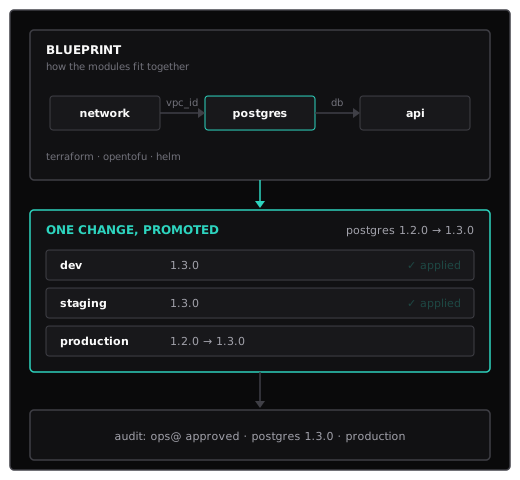
A blueprint connects a network, a Postgres database, and an API, passing the VPC ID and the database connection between them. One change takes Postgres from 1.2.0 to 1.3.0 in dev and staging, waits for approval in production, and lands once ops approves, with an audit record of the change.

Your Terraform works. The organization around it is the problem.

Teams looking for a platform orchestrator are past the question of whether to use Terraform. They have hundreds of workspaces or root modules, a module library that took years to get right, and a runner that plans and applies reliably. What they lack is the layer that turns all of that into something product teams can use without a platform engineer in the loop.

The signs are familiar. The dependency between the network and the database lives in remote state lookups that one person wrote. Staging and production are separate workspaces with separate variable files, and they drift until a change that passed in staging fails in production. Who may apply to production is split across the runner’s team settings, branch protection, and the cloud console. Every new team that wants infrastructure adds tickets, and every new caller, from a CI job to an AI coding agent, needs its own credentials.

Terraform orchestrates resources inside one root configuration. A platform orchestrator governs how teams select, compose, configure, deploy, and update those configurations across the whole organization, so every change takes one path.

Runner, portal, or orchestrator

These tools solve different layers of the same problem, and many teams run more than one. The table shows what each covers and what is left over.

  • HCP Terraform or Terraform Enterprise

    What it covers well

    Terraform runs, remote state, a private registry, policy as code with Sentinel or OPA, and no-code provisioning for single modules.

    What it leaves to your team

    A model of how modules compose into an application environment, how environments relate to each other, and one path for Helm and for non-human callers.

  • Spacelift

    What it covers well

    Orchestration across many IaC tools, policy as code, stack dependencies, and private workers.

    What it leaves to your team

    The developer-facing abstraction: a catalog of approved components, the form a developer fills in, and environments built from one blueprint.

  • Backstage with an IaC runner

    What it covers well

    A portal with a software catalog in front of a runner your team already trusts.

    What it leaves to your team

    The platform semantics in between, which your team writes as templates, custom actions, and pipelines and then maintains.

  • Build your own

    What it covers well

    A platform shaped exactly to your organization.

    What it leaves to your team

    Ten systems, about 54 engineer-months for a first production version, and a product team to keep it running.

  • Massdriver

    What it covers well

    Your Terraform, OpenTofu, and Helm as a catalog, composed into projects with typed connections, environments from one blueprint, attribute-based access, approvals, and an audit trail on every change.

    What it leaves to your team

    Writing the modules and deciding the rules. A runner you already use can keep running workspaces during a migration.

How Massdriver orchestrates Terraform

Your modules stay as they are. Massdriver adds the model around them: projects, environments, links, and policy.

A project holds the blueprint

A project is a graph of components connected by links, and each component is backed by a published bundle. Add a component once and every environment in the project gets an instance of it.

Links wire outputs to inputs

A link says one component’s output feeds another component’s input. When both deploy in an environment, Massdriver passes the producing instance’s output to the consuming instance, with no remote state lookups to maintain.

Attributes drive access

Projects, environments, and components carry attributes such as team or data classification. Group policies allow or deny actions where those attributes match, and policies apply to environments that do not exist yet.

Production needs two people

With separation of duty on, a deployment proposed in an environment must be approved by someone other than the proposer. Decommission protection stops anyone from tearing the environment down.

One change, followed through the orchestrator

The ecommerce project has a network, a Postgres database, and a checkout service. The team needs a larger database instance before a sale.

  1. 1

    The blueprint already knows the dependencies

    The database is linked to the network and the checkout service is linked to the database. Nobody has to look up which workspace reads which remote state.

  2. 2

    The change starts in staging

    An engineer changes the instance size on the staging database. The bundle’s schema accepts only the sizes your platform team allows, and the change applies under the staging policy.

  3. 3

    Policy runs before the apply

    Policy checks (SOC 2, HIPAA, CIS) run against the plan. A failed check stops the change before anything is created.

  4. 4

    Production is the same component

    Production has its own instance of the same database component, so the engineer proposes the same change there. Group policy lets the engineer propose in production and lets only leads deploy.

  5. 5

    A second person approves

    Separation of duty requires someone other than the proposer to approve. Massdriver then runs the apply with the cloud credentials it holds, and the new connection details reach the checkout service through the link.

  6. 6

    The record is complete

    The change carries the proposer, the approver, the diff, the policy results, and the outcome. A CI job or an AI agent making the same change would leave the same record, because it uses the same path.

When you do not need a platform orchestrator

An orchestrator earns its place when many teams change infrastructure and the rules for those changes matter. Some organizations are not there yet, and a good runner is all they need.

One person or one small team makes every change
If a single infrastructure engineer runs every apply, the coordination problems an orchestrator solves have not appeared yet.
You have a handful of modules
A few modules with few dependencies between them are easy to keep straight in a runner.
Infrastructure tickets do not slow anyone down
If requests are rare and turnaround is fast, self-service is solving a problem you do not have.
Compliance pressure is low
If nobody asks who approved a production change, the approval and audit features matter less today. They tend to matter after the first customer security review.

Mentaware Moved from AWS to Azure and Deploys 60x Faster

“Massdriver has been a game-changer for us. It transformed our deployment process, making it far more efficient and manageable. The visual connections, zero-downtime deployments, and ease of adding new microservices have saved us countless hours.”

Sebastian Galustyan — Chief Technical Officer
  • âś“60x faster deployments
  • âś“95% less CI/CD setup time
  • âś“Migrated from AWS to Azure and expanded into new regions

Massdriver in two minutes

A two-minute overview of Massdriver, the platform orchestrator for the Terraform, OpenTofu, and Helm your team already writes.

Platform orchestrator questions

A platform orchestrator sits between the people and systems that request infrastructure and the infrastructure as code that builds it. It holds the catalog of approved components, knows how they depend on each other across environments, enforces who may change what, and runs each deploy. An internal developer platform is usually a portal on top of one.

Terraform orchestrates the resources inside one root configuration. A platform orchestrator works one level up, across many configurations, teams, and environments, and decides who may change each one.

Running plan and apply is one part of it. The catalog, the composition of modules, input schemas, permissions, policy, approvals, state, audit, and the developer interface are the rest.

If your problem is central Terraform execution, state, and policy, HCP Terraform may be enough. Massdriver is for turning infrastructure into self-service for many teams, CI, and agents on one governed path.

No. Terraform and OpenTofu run as the provisioner for each bundle step, and Helm charts deploy as bundles too. Each module gets a massdriver.yaml that declares its inputs, connections, and outputs.

Yes. You can move one workspace at a time, and resource import brings existing infrastructure under management without a redeploy.

Yes. The Massdriver Terraform provider manages projects, environments, components, component links, groups, group policies, and resource grants.

They use the same path as people. An agent or a pipeline gets a scoped token, works through the CLI, the API, or the MCP server, and is bound by the same policies and approvals as an engineer.

Get your platform built.

Give us an hour with your platform and security leads and have a working governed path to production on your own infrastructure within a day, then prove it for 30 days. If you stop, you keep the code.