Upcoming Workshop: Citizen Developer Agentic Software Factory on AWS

Register Here!

Terraform developer self-service without turning developers into Terraform operators

Your modules already encode how infrastructure should be built. Developers still file tickets, because using a module means learning HCL, holding cloud credentials, and waiting for someone on the platform team to review the plan.

Massdriver turns each module into a catalog entry with a validated form, runs the deploy under your policy, and records who changed what. Developers, CI, and AI agents all use the same path.
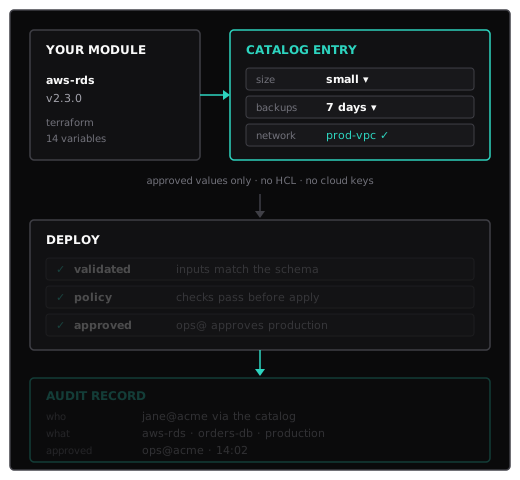
Your aws-rds Terraform module becomes a catalog entry with a size picker, a backup setting, and a network that connects itself. Developers pick approved values with no HCL and no cloud keys. The deploy validates the inputs, runs policy checks, and waits for ops to approve production, and the audit record shows who changed what and who approved it.

The modules are good. The queue in front of them keeps growing.

A platform team with a healthy Terraform estate usually has a module for everything that matters: the network, the database, the cache, the cluster. The modules are versioned, reviewed, and tagged the way your organization wants. Then someone looks at the ticket queue and sees that half of it is requests to run those modules with different variables.

The modules are rarely what slows things down. A module’s variables accept any instance size and any engine version, and which values your organization allows lives in a reviewer’s head. Running it needs cloud credentials and access to state, which are exactly what you do not want to hand every developer. The database needs the network’s subnets and the app needs the database’s connection string, so someone copies outputs into inputs once per environment.

Self-service for Terraform means moving those decisions out of people’s heads and into something that enforces them. Developers ask for what they need in terms they understand, and the platform team’s rules decide what actually runs.

How teams expose Terraform to developers today

Each approach works for some teams. The difference is how much your platform team keeps maintaining as the module library and the number of requesters grow.

  • A README and terraform apply

    What developers get

    Full autonomy. Developers run the module themselves with their own variables.

    What the platform team keeps doing

    Teaching state, providers, and credentials to every team, and cleaning up when an apply goes wrong in the wrong account.

  • Pull request templates

    What developers get

    A reviewed change for every request, with history in version control.

    What the platform team keeps doing

    Reviewing every plan by hand. The ticket queue moves into pull requests and keeps its length.

  • A form in front of a pipeline

    What developers get

    A simple request form for the first few modules, built on tools you already run.

    What the platform team keeps doing

    A form, validation, pipeline, credentials, state, policy, and teardown for each module, plus the wiring between modules.

  • HCP Terraform no-code modules

    What developers get

    A form for an approved module in your private registry, with Sentinel or OPA policy and run history.

    What the platform team keeps doing

    Each module still deploys on its own. Wiring outputs between modules, and treating staging and production as one blueprint, stays with your team.

  • Spacelift

    What developers get

    Strong orchestration across Terraform, OpenTofu, and other IaC tools, with policy as code and stack dependencies.

    What the platform team keeps doing

    The developer-facing model: which components a team may add, how environments relate, and the form a developer sees.

  • Massdriver

    What developers get

    A catalog of your modules with forms built from their schemas, connections that wire outputs to inputs, environments from one blueprint, and policy and approvals on every change.

    What the platform team keeps doing

    Writing the modules and the rules for who may change what, which your team already owns.

How a module becomes self-service

Your Terraform stays Terraform. Massdriver adds a contract around it and runs it.

Declare the inputs you allow

A massdriver.yaml next to the module declares its inputs as JSON Schema: types, allowed values, patterns, defaults, and fields that cannot change once the resource exists. The form a developer sees is built from it, so values outside your rules cannot be submitted.

Declare what it needs and produces

Connections name the resources a module consumes, such as a network. Artifacts name what it produces, such as a database. Massdriver passes one component’s output to the next component’s input in every environment.

Deploy without handing out keys

Massdriver generates the pipeline for each deploy, checks policy before apply, and holds the cloud credentials itself. A developer or an agent never receives a cloud key.

What happens when a developer asks for a Redis cache

An engineer on the search team needs a cache for a new service. Your platform team already has a Redis module.

  1. 1

    The platform team publishes the module once

    The team adds a massdriver.yaml next to the existing Redis module. It allows three node sizes, the engine versions you support, and a naming pattern, and it says the cache needs a network. The module code does not change.

  2. 2

    The developer picks it from the catalog

    In the search team’s project, the engineer adds the Redis component and connects it to the service that will use it. The form shows the three sizes and the supported versions. There is no field for the subnet, because the network connection supplies it.

  3. 3

    Validation and policy run before anything is created

    Massdriver checks the inputs against the schema and checks the team’s policy for that environment. Policy checks (SOC 2, HIPAA, CIS) run against the plan.

  4. 4

    Massdriver applies with its own credentials

    The generated pipeline plans and applies. The cache’s connection details pass to the service. The engineer never sees a cloud key or a state file.

  5. 5

    Production gets the same component

    The project is a blueprint, so production gets its own instance of the same component. With separation of duty on in production, someone other than the engineer approves the change before it applies.

  6. 6

    Day two uses the same path

    When the platform team ships a new version of the Redis module, instances move to it through the same catalog, policy, and approval. Each change carries the proposer, the approver, the diff, and the result.

When HCP Terraform no-code modules are enough

If your organization already runs HCP Terraform and your requests are mostly one module at a time, no-code provisioning may cover what you need. It gives developers a form for an approved module and keeps runs and policy in a system your team already operates.

Requests are for single, independent resources
A bucket here, a queue there, with nothing to wire between them. Per-module forms work well for that.
Your environments are simple
If staging and production differ in a few variables and rarely drift, managing them as separate workspaces is fine.
One team reviews every production change
If production goes through a few platform engineers anyway, approval rules in the tool matter less.

GameStake Adopted Terraform and Managed Kubernetes in One Week, and Cut Cloud Spend 25%

“I really like that I can easily see the cost of each service I have provisioned, split by project and deployment environment. This feature has helped us save almost 25% of our monthly cloud costs.”

Ivan Ivanov — Head of Engineering
  • âś“Reduced cloud spend by 25%
  • âś“Full migration in one week, with zero-downtime deployments afterward
  • âś“100% of infrastructure managed as code

Massdriver in two minutes

A two-minute overview of how Massdriver turns your platform team’s modules into self-service that stays inside policy.

Terraform self-service questions

No. Developers fill in a form generated from the bundle’s schema, or connect components on a diagram. The platform team keeps writing Terraform, OpenTofu, and Helm.

No. Terraform becomes the layer your team builds the platform from, and product teams stop needing to touch it.

No. Each module gets a massdriver.yaml that declares its inputs, connections, and outputs. Your existing code is the starting point.

Yes. Each bundle step names its provisioner, such as opentofu:1.10 or a Terraform version, and Helm charts are bundles too. Developers do not need to know which tool runs underneath.

Resource import brings existing infrastructure under Massdriver management without a redeploy, and state moves with the instance. Most teams move one service or one workspace at a time.

Only within the rules you write. Attribute-based policies decide who can plan, propose, or deploy in each environment, and separation of duty requires a second person to approve a production deployment.

Yes. The CLI, the GraphQL API, the Terraform provider, and the MCP server all go through the same catalog and the same policy. An agent gets a scoped token, never a cloud key.

Get your platform built.

Give us an hour with your platform and security leads and have a working governed path to production on your own infrastructure within a day, then prove it for 30 days. If you stop, you keep the code.