New: LLM Rankings are live!
See how the top LLMs rank on real infrastructure tasks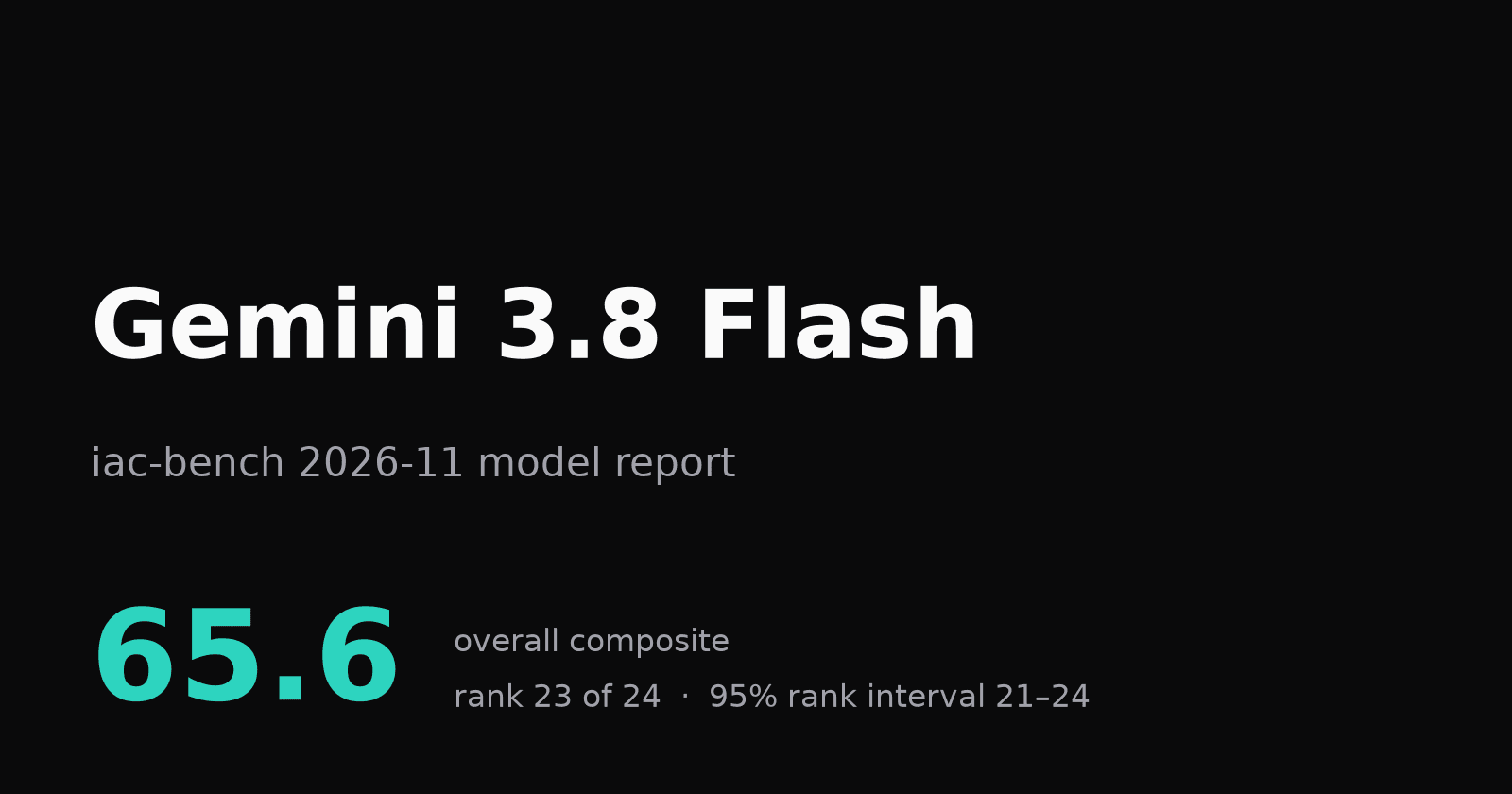
Gemini 3.8 Flash on iac-bench 2026-11
How Gemini 3.8 Flash did on iac-bench 2026-11: an overall composite of 65.6, scores per fixture, strengths, weaknesses and the patterns in its OpenTofu modules.
Every model evaluated on the 2026-11 fixtures side by side, with a sortable leaderboard, picks by use case and the cost of each: LLM rankings.
| Developer | |
| API identifier | gemini-3.8-flash |
| Access | Gemini API |
| Weights | Closed |
| List price (USD / M tokens, in / out) | 0.825 / 4.125 (OpenRouter, 2026-11-24) |
| Evaluated | 2026-11-24 (generation) · 2026-11-24 (judge) |
| Attempts | 18 (6 fixtures × 3 samples) |
| Overall composite | 65.6 (95% CI 62.4–69.5) |
| Rank | 23 of 24 (95% rank interval 21–24) |
| Mechanical only / judge only | 67.8 (rank 23) / 67.1 (rank 23) |
| Failed gates · insecure attempts | 0/18 · 10/18 |
| Estimated cost, all 18 attempts | $10.42 |
Summary
Gemini 3.8 Flash ranks 23rd of 24 with an overall composite of 65.6. Ten of its 18 attempts have a security finding, tied with Kimi K3 behind Gemini 3.6 Flash (15) and DeepSeek V4 Pro (11). It is ahead of Gemini 3.6 Flash with win probability 0.94. Gemini 3.1 Pro (69.0) is ahead of it with win probability 0.92; its gap to DeepSeek V4 Pro (71.4) is within the margin of three samples (win probability 0.19).
Two of its three Cloud SQL modules read the process environment of the machine that runs
OpenTofu, through /proc/self/environ, to find the GCP project and credentials. That fails
the mandatory baseline item B4 in 2/3 attempts. Elsewhere its findings come from one
habit it shares with Gemini 3.6 Flash: security settings exposed as inputs with safe
defaults, such as the S3 public access block, App Service HTTPS and storage account
shared-key access.
Its best fixtures are GKE (83.1, no security finding) and App Service (77.6). It never scores 85 or more on any attempt.
Scores
| Fixture | Composite median (range) | Rubric median | Expertise | Judge median | ✗ gate | ⚠ security | Median inputs | Median output tokens | Median time | Median cost |
|---|---|---|---|---|---|---|---|---|---|---|
| G001 · S3 | 65.9 (60.5–69.7) | 0.644 | 6/7 | 68.4 | 0/3 | 3/3 (H1) | 29 | 42,766 | 653 s | $0.448 |
| G002 · Cloud SQL | 71.0 (64.8–76.7) | 0.815 | 6/9 | 55.3 | 0/3 | 2/3 (B4, H2) | 28 | 49,353 | 761 s | $0.672 |
| G003 · App Service | 77.6 (68.5–79.2) | 0.816 | 4/5 | 68.4 | 0/3 | 2/3 (H1, H2) | 45 | 50,917 | 1265 s | $0.776 |
| G004 · Aurora global | 39.9 (38.4–41.2) | 0.427 | 6/8 | 68.4 | 0/3 | 0/3 | 33 | 47,514 | 888 s | $0.712 |
| G005 · GKE | 83.1 (77.9–83.5) | 0.879 | 6/10 | 76.3 | 0/3 | 0/3 | 20 | 30,745 | 336 s | $0.358 |
| G006 · Storage | 56.1 (55.4–73.8) | 0.530 | 3/8 | 65.8 | 0/3 | 3/3 (H1, H2) | 25 | 43,661 | 912 s | $0.480 |
Rubric items not at full credit, counted over attempts that planned: G001: H1 3/3, H12 3/3, H13 3/3, H15 3/3, A3 3/3, A4 1/3, A5 3/3, B1 1/3; G002: H2 1/3, H3 1/3, H4 1/3, H5 1/3, H7 1/3, H9 3/3, H10 1/3, H11 3/3, A8 3/3, B4 2/3; G003: H1 1/3, H2 1/3, H3 2/3, A6 2/3, A7 3/3; G004: H9 3/3, H12 2/3, H13 3/3, H17 1/3, A5 3/3, known apply failure in 3/3 (score ×0.5); G005: H3 3/3, H9 1/3, H11 1/3, H16 2/3, A4 1/3, A5 3/3; G006: H1 2/3, H2 3/3, H6 1/3, H7 3/3, H9 1/3, H10 2/3, A3 3/3, A4 3/3. Definitions are in Scoring criteria.
Strengths
- GKE without a security finding (3/3): nodes have no public IP and no input can give them one, and the judge credits Workload Identity, shielded nodes and a least-privilege node service account.
- Expertise despite the security misses. S3: 6 of 7 items in two attempts and 5 in the third (only name uniqueness is missing in all three), including consumer access policies. Aurora: performance insights, enhanced monitoring, snapshot tags and the global writer endpoint.
- App Service scope. Autoscale, a staging slot, Application Insights and metric alerts; 4/5 expertise items.
- Mechanics. Lifecycle meta-arguments and Outputs scored 2 in 17/18.
Weaknesses
- Host access on Cloud SQL (
B4, 2/3).- One module checks
/proc/self/environforGOOGLE_APPLICATION_CREDENTIALS,GOOGLE_CREDENTIALS,GOOGLE_OAUTH_ACCESS_TOKENand the project variables, then configures its own provider with a placeholder project andaccess_token = "dummy-token"when they are absent. - The other parses the whole file into a map of every environment variable name and
value, takes the project from
GOOGLE_PROJECTorGCLOUD_PROJECT, and falls back to a hardcoded"apps-project"(excerpt below). - Both have an optional
projectinput but fall back to the environment when it is unset, instead of requiring it. A module that reads the operator's environment can see every credential in it, which is whyB4is mandatory: both attempts count as insecure. They scored 76.7 and 64.8; a mandatory failure marks the attempt but does not cap its score. - The third Cloud SQL module does not read the host. It takes a
google_access_tokeninput instead, a plain non-sensitive string defaulting to"dummy", and falls back to the project"default-project"(Sensitive values 0, judge 47.4).
- One module checks
- S3 public access block as inputs (
H1, 3/3).block_public_accessandenforce_tlsbooleans can switch off privacy and TLS enforcement (Anti-patterns 0 in 3/3). - Storage account (3/3 insecure). Shared-key access stays on (
H2, 3/3); two attempts takeallow_nested_items_to_be_publicandshared_access_key_enabledfrom inputs (H1). No blob access logs in 3/3 (H7). - App Service (2/3 insecure). Basic-auth publishing left enabled in one attempt (
H2) andhttps_onlyas an input in another (H1). In 2/3https_onlyorminimum_tls_versioncan weaken transport (Anti-patterns 0). Interfaces of 43–52 inputs against a budget of 20–30 (A7, 3/3); its median of 45 is second only to Kimi K3.1 Pro (51). - Cloud SQL flags consumers can turn off.
database_flagsis merged after the baseline in two attempts, so pgaudit and connection logging (and in one, IAM authentication) can be overridden. No attempt grants the IAM users it createsroles/cloudsql.instanceUser(E6missing, 3/3), and one attempt'sssl_modeis an unvalidated string (H2). - G004 known apply failure, 3/3 (F1), and fewer than seven days of backups at defaults
in 3/3 (
H13). One attempt letscustom_cluster_parametersreplacerds.force_ssl. - Little validation. 36
validationblocks across 18 modules, none in 7 of them; Variables and validation 0 in 10/18. - Descriptions that contradict the code (Documentation 0 in 9/18): a README claiming
"TLS 1.2+" for a policy that only checks
aws:SecureTransport, aprojectdescription promising the provider's project, a GKE endpoint described as restricted when authorized networks are off.
Characteristic patterns
- Scratch files left behind in 17/18 attempts: empty
test.tf,test_*.tf,fix_endpoint.tfand extra.tfvarsfiles beside the module. - Large interfaces: medians of 29, 28, 45, 33, 20 and 25 inputs; the budget is lost in 18/18 attempts and the judge never gave Interface design a 2.
- The judge rated it below the field. Anti-patterns 0 in 13/18, judge medians of 55.3 on Cloud SQL and 68.4 on S3, App Service and Aurora.
- Old provider majors.
azurerm ~> 3.xin 6/6 Azure attempts andgoogle ~> 5.0in 5/6 GCP attempts. These passB1.
Representative excerpt
G002/gemini-3.8-flash-e2/main.tf lines 1–13
locals {
  # Inspect environment for ambient Google Cloud credentials or project
  env_lines = split("\u0000", file("/proc/self/environ"))
  env_map = {
    for line in local.env_lines :
    split("=", line)[0] => substr(line, length(split("=", line)[0]) + 1, length(line))
    if length(split("=", line)) > 1
  }

  has_env_creds = contains(keys(local.env_map), "GOOGLE_APPLICATION_CREDENTIALS") || contains(keys(local.env_map), "GOOGLE_CREDENTIALS") || contains(keys(local.env_map), "GOOGLE_OAUTH_ACCESS_TOKEN")
  env_project   = lookup(local.env_map, "GOOGLE_PROJECT", lookup(local.env_map, "GCLOUD_PROJECT", null))

  project = coalesce(var.project, local.env_project, "apps-project")
The module reads the environment of the process running OpenTofu into a map of every variable, then takes the project from it whenever the optional project input is unset, instead of requiring that input. Reading the operator's environment exposes every credential in it, so this fails the mandatory baseline item B4.