New: LLM Rankings are live!
See how the top LLMs rank on real infrastructure tasks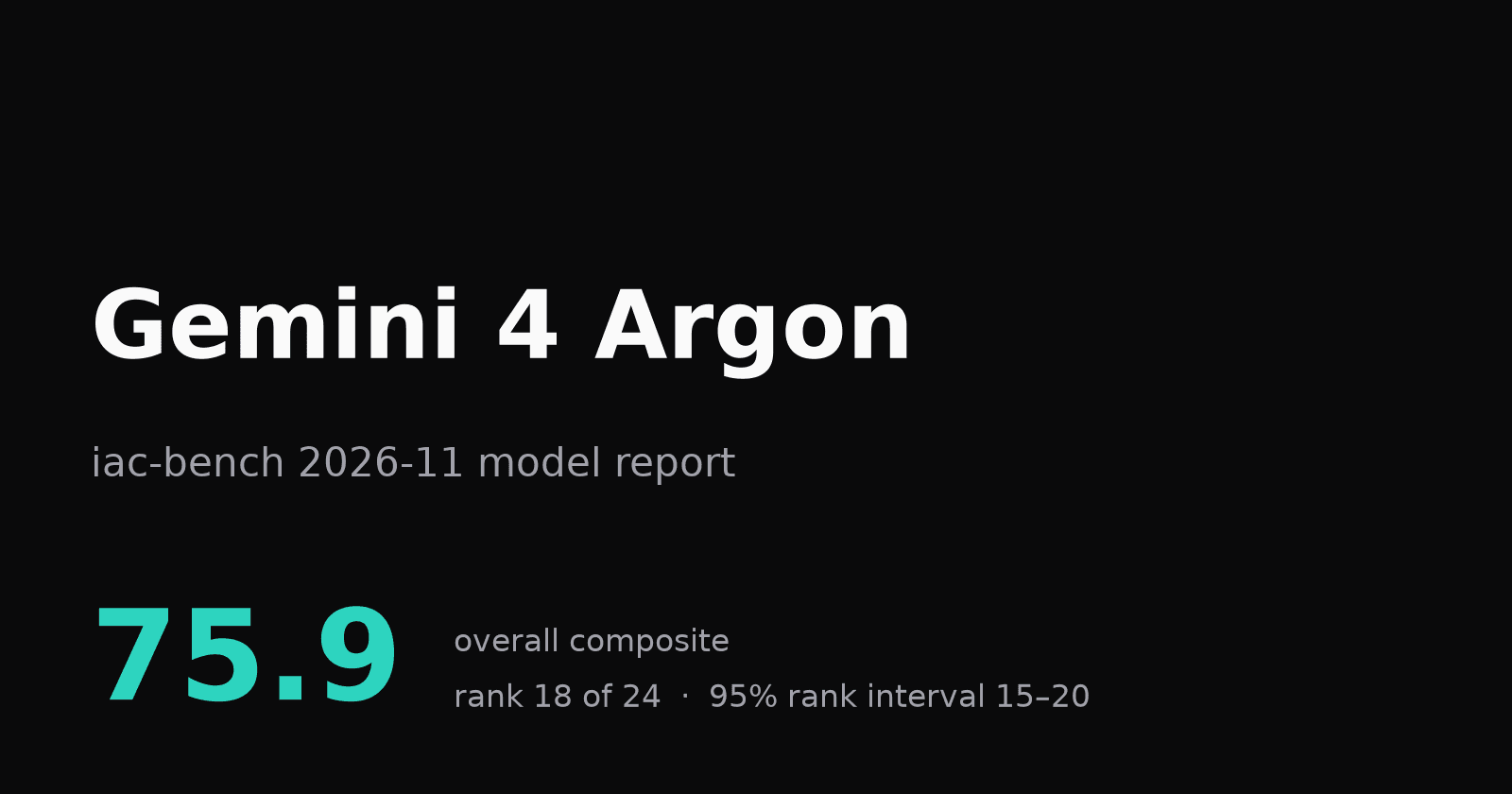
Gemini 4 Argon on iac-bench 2026-11
How Gemini 4 Argon did on iac-bench 2026-11: an overall composite of 75.9, scores per fixture, strengths, weaknesses and the patterns in its OpenTofu modules.
Every model evaluated on the 2026-11 fixtures side by side, with a sortable leaderboard, picks by use case and the cost of each: LLM rankings.
| Developer | |
| API identifier | gemini-4-argon |
| Access | Gemini API |
| Weights | Closed |
| List price (USD / M tokens, in / out) | 2.0 / 10.0 (OpenRouter, 2026-11-24) |
| Evaluated | 2026-11-23 (generation) · 2026-11-24 (judge) |
| Attempts | 18 (6 fixtures × 3 samples) |
| Overall composite | 75.9 (95% CI 74.4–77.7) |
| Rank | 18 of 24 (95% rank interval 15–20) |
| Mechanical only / judge only | 76.4 (rank 17) / 82.0 (rank 19) |
| Failed gates · insecure attempts | 0/18 · 1/18 |
| Estimated cost, all 18 attempts | $3.68 |
Summary
Gemini 4 Argon ranks 18th of 24 with an overall composite of 75.9, the lowest of the four Gemini 4 models. Its neighbors are not ordered: against GLM-5.3 (76.8), Qwen3.8 2.4T-A95B (75.7) and Kimi K3 (74.4) its win probabilities are 0.37, 0.48 and 0.77. Gemini 4 Hydrogen is ahead of it with win probability 0.90. One of its 18 attempts has a security finding.
It writes the smallest modules of the Gemini 4 family. Its 18 attempts used 210,694 output tokens and cost $3.68 in total, against 939,901 tokens and $26.54 for Gemini 4 Neon. Its interfaces are the smallest in its family, and it is the only Gemini 4 model that meets the Cloud SQL and App Service budgets in every attempt. What the shorter modules give up is some of the settings the rubric checks: a public GKE control plane at defaults, a fixed control-plane range, and no blob access logs.
On G004 all three modules have Secrets Manager manage the master password on member clusters of the global database, a known apply failure that halves the composite (41.0). Its medians on the other five fixtures are 79.9–87.1.
Scores
| Fixture | Composite median (range) | Rubric median | Expertise | Judge median | ✗ gate | ⚠ security | Median inputs | Median output tokens | Median time | Median cost |
|---|---|---|---|---|---|---|---|---|---|---|
| G001 · S3 | 81.8 (80.1–83.3) | 0.782 | 7/7 | 86.8 | 0/3 | 0/3 | 20 | 8,268 | 281 s | $0.120 |
| G002 · Cloud SQL | 87.1 (86.3–88.0) | 0.855 | 7/9 | 92.1 | 0/3 | 0/3 | 19 | 5,073 | 115 s | $0.092 |
| G003 · App Service | 83.0 (80.7–85.1) | 0.874 | 4/5 | 71.1 | 0/3 | 0/3 | 15 | 22,657 | 299 s | $0.330 |
| G004 · Aurora global | 41.0 (40.9–41.8) | 0.417 | 6/8 | 78.9 | 0/3 | 0/3 | 31 | 17,310 | 635 s | $0.486 |
| G005 · GKE | 82.9 (82.5–84.3) | 0.850 | 7/10 | 81.6 | 0/3 | 0/3 | 12 | 4,518 | 86 s | $0.076 |
| G006 · Storage | 79.9 (73.1–87.3) | 0.830 | 5/8 | 81.6 | 0/3 | 1/3 (H2) | 16 | 10,940 | 395 s | $0.232 |
Rubric items not at full credit, counted over attempts that planned: G001: H12 3/3, H13 3/3, H15 3/3, A5 3/3, B1 3/3; G002: H3 3/3, H4 2/3, H9 3/3, H11 3/3, B1 3/3; G003: H3 1/3, H4 1/3, A6 3/3, B1 2/3; G004: H9 3/3, H17 2/3, A5 3/3, B1 3/3, known apply failure in 3/3 (score ×0.5); G005: H3 3/3, H9 2/3, H16 3/3, A5 3/3, B1 3/3; G006: H2 1/3, H7 3/3, A4 3/3, B1 3/3. Definitions are in Scoring criteria.
Strengths
- Interfaces within budget on the specialist fixtures. 19–20 inputs on Cloud SQL
(budget 25–35) and 14–17 on App Service (budget 20–30), so
A8andA7are never lost. On App Service its median of 15 is among the three smallest in the field. - Security posture fixed in 17/18 attempts.
- App Service: HTTPS-only and disabled basic-auth publishing on the app and the slot in 3/3.
- Cloud SQL: private IP and encrypted-only connections in 3/3, with required flags merged
after the consumer's
database_flags.
- S3 expertise 7/7 in 3/3, with no CloudFront or website configuration (
A4kept in 3/3, which the other three Gemini 4 models lose in 3/3). - Concept inputs.
app_name,environmentandpurposeon S3;environmentandregionderive the VPC and subnet on GKE. - Outputs scored 2 in 18/18, as did Lifecycle meta-arguments and Deprecated patterns.
Weaknesses
- G004 known apply failure, 3/3 (F1), with
H9and the interface budget lost in 3/3 (27–38 inputs against 12–22), and a default engine version that AWS does not offer for global databases in 2/3 (H17). In 3/3 the consumer'scluster_parametersare merged over the defaults, sords.force_sslcan be set to 0 (Anti-patterns 0). - App Service transport.
minimum_tls_versionis an unvalidated input in one attempt (Anti-patterns 0), and the judge median is 71.1. - GKE control plane. The endpoint is public by default and the authorized-networks
block is omitted when its list is empty, so the API server is open at defaults (
H3, 3/3). The private range defaults to a fixed172.16.0.0/28that clusters in the same VPC would share (H16, 3/3). Secrets encryption with a customer key is missing in 2/3 (H9). - Storage account. One attempt exposes
shared_access_key_enabledas an input (H2, the security finding; Anti-patterns 0). No attempt sends blob access logs anywhere (H7, 3/3). - Provider constraints that admit a new major (
>= 5.0,>= 3.80.0and similar) in 17/18 attempts (B1). - Cloud SQL. No
deletion_policythat keeps removed databases (H11, 3/3), deletion protection at half credit (H3, 3/3), and noroles/cloudsql.instanceUsergrant for the IAM users it creates (E6missing in 3/3). - Descriptions that promise behavior the code lacks (Documentation 0 in 8/18,
including 3/3 on App Service): a
force_destroy"disallowed in prod" that is passed straight through, App Service "auto-heal" and "traffic routing" that are never configured, a SAS expiration "limit" that only logs.
Characteristic patterns
- Four files. Its 15 modules outside G004 have 4 or 5
.tffiles (main.tf,variables.tf,outputs.tfandversions.tfin most), no attempt ships a README, and no module outside G004 has a precondition. The judge gave File layout 1 in 13/18 formain.tffiles of 200–600 lines. - Less validation than the rest of its family: 6–19
validationblocks per module (220 across 18), against 449 for Gemini 4 Neon. - Short generations. Median output tokens per fixture of 4,518–22,657; the GKE and Cloud SQL medians are under 5,100.
Representative excerpt
G005/gemini-4-argon-e2/main.tf lines 71–83
  private_cluster_config {
    enable_private_nodes    = true
    enable_private_endpoint = var.enable_private_endpoint
    master_ipv4_cidr_block  = var.master_ipv4_cidr_block

    master_global_access_config {
      enabled = true
    }
  }

  dynamic "master_authorized_networks_config" {
    for_each = length(var.master_authorized_networks) > 0 || var.enable_private_endpoint ? [1] : []
    content {
Nodes are private, but the endpoint is public by default and the authorized-networks block is left out when its list is empty, so the control plane is open at defaults (G005 H3). The private range comes from a fixed default shared by every cluster in the VPC (H16). Both are lost in 3/3 attempts.