New: LLM Rankings are live!
See how the top LLMs rank on real infrastructure tasks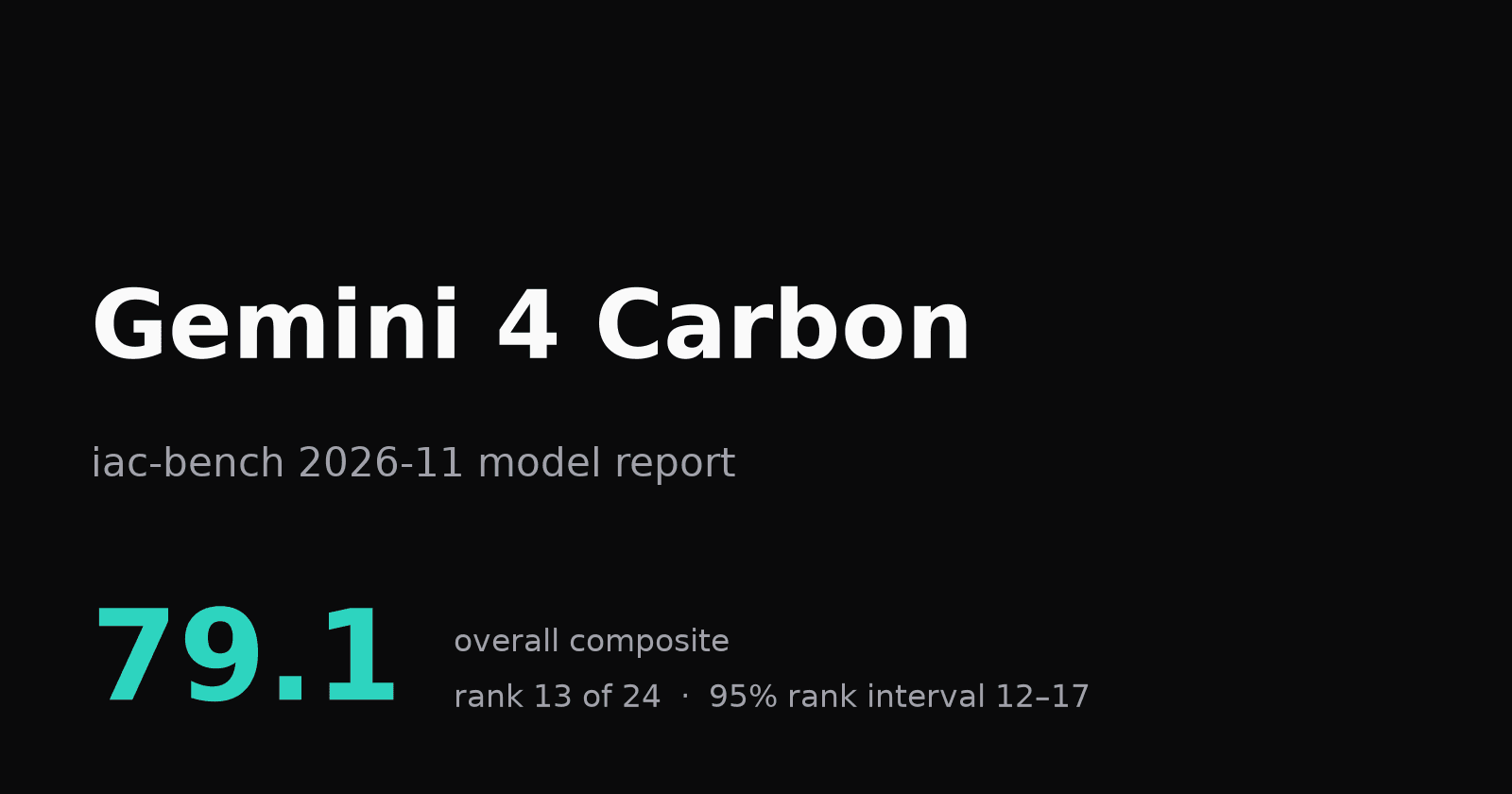
Gemini 4 Carbon on iac-bench 2026-11
How Gemini 4 Carbon did on iac-bench 2026-11: an overall composite of 79.1, scores per fixture, strengths, weaknesses and the patterns in its OpenTofu modules.
Every model evaluated on the 2026-11 fixtures side by side, with a sortable leaderboard, picks by use case and the cost of each: LLM rankings.
| Developer | |
| API identifier | gemini-4-carbon |
| Access | Gemini API |
| Weights | Closed |
| List price (USD / M tokens, in / out) | 2.0 / 10.0 (OpenRouter, 2026-11-24) |
| Evaluated | 2026-11-23 (generation) · 2026-11-24 (judge) |
| Attempts | 18 (6 fixtures × 3 samples) |
| Overall composite | 79.1 (95% CI 77.1–80.1) |
| Rank | 13 of 24 (95% rank interval 12–17) |
| Mechanical only / judge only | 79.3 (rank 13) / 86.4 (rank 14) |
| Failed gates · insecure attempts | 0/18 · 2/18 |
| Estimated cost, all 18 attempts | $16.36 |
Summary
Gemini 4 Carbon ranks 13th of 24 with an overall composite of 79.1. The two models below it are not ordered against it: its win probabilities against Qwen4 Max (78.9) and Gemini 4 Hydrogen (78.6) are 0.39 and 0.64. Gemini 4 Neon is ahead of it with win probability 0.97, and it is ahead of GPT-6 Luna (77.3) with 0.93. Two of its 18 attempts have a security finding, both on App Service.
Its best fixture is GKE (median 91.0, the highest of the Google models there), followed by Cloud SQL and the storage account (87.8 and 87.1). On G004 all three modules have Secrets Manager manage the master password on member clusters of the global database, a known apply failure that halves the composite: 43.2 instead of about 85–87.
Like Gemini 4 Neon, it hardcodes most security settings, includes most expertise items and builds large interfaces. Where it differs is App Service, where single posture settings are left as inputs with safe defaults.
Scores
| Fixture | Composite median (range) | Rubric median | Expertise | Judge median | ✗ gate | ⚠ security | Median inputs | Median output tokens | Median time | Median cost |
|---|---|---|---|---|---|---|---|---|---|---|
| G001 · S3 | 83.7 (79.7–84.5) | 0.812 | 7/7 | 86.8 | 0/3 | 0/3 | 27 | 42,067 | 1007 s | $0.803 |
| G002 · Cloud SQL | 87.8 (84.1–88.7) | 0.847 | 8/9 | 97.4 | 0/3 | 0/3 | 28 | 37,788 | 747 s | $0.774 |
| G003 · App Service | 81.5 (75.8–85.5) | 0.816 | 5/5 | 81.6 | 0/3 | 2/3 (H1, H2) | 21 | 55,024 | 1642 s | $1.003 |
| G004 · Aurora global | 43.2 (42.3–43.4) | 0.440 | 7/8 | 84.2 | 0/3 | 0/3 | 36 | 60,906 | 2660 s | $1.168 |
| G005 · GKE | 91.0 (90.6–92.2) | 0.906 | 8/10 | 92.1 | 0/3 | 0/3 | 36 | 46,626 | 1014 s | $0.892 |
| G006 · Storage | 87.1 (84.8–89.5) | 0.920 | 7/8 | 76.3 | 0/3 | 0/3 | 26 | 41,186 | 1208 s | $0.761 |
Rubric items not at full credit, counted over attempts that planned: G001: H12 3/3, H13 3/3, H15 3/3, A4 3/3, A5 3/3, B1 1/3; G002: H3 2/3, H5 1/3, H9 3/3, H11 3/3, A8 3/3, B1 3/3; G003: H1 1/3, H2 1/3, H3 3/3, A6 3/3, A7 2/3, B1 2/3; G004: H9 3/3, H12 3/3, A5 3/3, B1 1/3, known apply failure in 3/3 (score ×0.5); G005: A5 3/3, B1 2/3; G006: A4 3/3. Definitions are in Scoring criteria.
Strengths
- Expertise. 7/7 on S3 and 5/5 on App Service (including Key Vault references, 16/72 field-wide) in every attempt, 8/9 on Cloud SQL, 8/10 on GKE and 7/8 on the storage account.
- GKE. Only the interface budget and provider constraints are lost; private nodes, a restricted control plane, secrets encryption and a non-fixed control-plane range are present in 3/3. The judge graded the three modules 89.5–92.1.
- Cloud SQL flags consumers cannot weaken. Its required security flags are merged after
the consumer's
database_flagsin 3/3. The judge graded the three modules 86.8–97.4. - Storage account. Shared-key access and nested public access are hardcoded off, and the
interface budget is the only rubric item lost (
A4, 3/3). - Validation with teaching messages. 15–29
validationblocks per module (382 across 18), plus preconditions such as the zone-redundancy check on the App Service plan and the distinct-region check on the Aurora global cluster.
Weaknesses
- G004 known apply failure, 3/3.
manage_master_user_password = trueon member clusters (F1). Also lost in 3/3:H9, final snapshots (H12) and the interface budget (36–37 inputs against 12–22). - App Service posture behind single inputs (2/3 insecure).
- One attempt hardcodes HTTPS-only and FTP basic auth off, but takes Web Deploy basic
auth from
rollout.basic_auth_publishing_enabled(H2, excerpt below). - Another takes
https_onlyfromavailability.https_only(H1), and itsip_restriction_default_action = "Allow"overrides the computedDeny(Anti-patterns 0). minimum_tls_versionis an input in 3/3, soH3is lost in 3/3.
- One attempt hardcodes HTTPS-only and FTP basic auth off, but takes Web Deploy basic
auth from
- Exposure overrides elsewhere. On the storage account
network_default_actionandpublic_network_access_enabledcan reopen a locked firewall (Anti-patterns 0 in 2/3). On GKE,security_posture_modeacceptsDISABLEDandauthorized_networksaccepts0.0.0.0/0(Anti-patterns 1 in 2/3). On Aurora, consumer cluster parameters are filtered forrds.force_sslonly, so other TLS and audit parameters can be overridden (Anti-patterns 1 in 2/3). - S3 gaps. Access logging that cannot deliver (
H13, 3/3), no provider block with a configurable region (H15, 3/3), CloudFront grants (A4, 3/3) and tags applied per resource (H12half credit). - Cloud SQL. No
deletion_policythat keeps removed databases (H11, 3/3), the region reaches the instance but not the provider (H9half credit, 3/3), and deletion protection at half credit in 2/3 (H3). - Interface size. Budget items lost in 17/18 attempts; Interface design 1 in 15/18.
Characteristic patterns
- Large interfaces, second only to Gemini 4 Neon among the Google models: medians of 27, 28, 21, 36, 36 and 26 inputs. It ties Gemini 3.6 Flash for the largest on the storage account.
- Inputs grouped into concept objects on App Service (
capacity,availability,health,rollout,observability), with raw attributes inside some of them. - Long
main.tffiles. File layout 1 in 6/18, for files of 250–500 lines mixing concerns. - One inaccurate description (Documentation 0 in 1/18): a Cloud SQL
deletion_protectiondescription promises environment-dependent behavior the variable does not have.
Representative excerpt
G003/gemini-4-carbon-e1/main.tf lines 42–49
  https_only                                     = true
  client_affinity_enabled                        = var.availability.client_affinity_enabled
  public_network_access_enabled                  = var.network.public_network_access_enabled
  virtual_network_subnet_id                      = var.network.vnet_integration_subnet_id
  vnet_image_pull_enabled                        = local.vnet_integrated
  key_vault_reference_identity_id                = var.key_vault_reference_identity_id
  ftp_publish_basic_authentication_enabled       = false
  webdeploy_publish_basic_authentication_enabled = var.rollout.basic_auth_publishing_enabled
HTTPS-only and FTP basic auth are literals, but Web Deploy basic auth comes from an input (default false), so one setting can turn shared publishing credentials back on. This fails the mandatory G003 H2 in this attempt.