New: LLM Rankings are live!
See how the top LLMs rank on real infrastructure tasks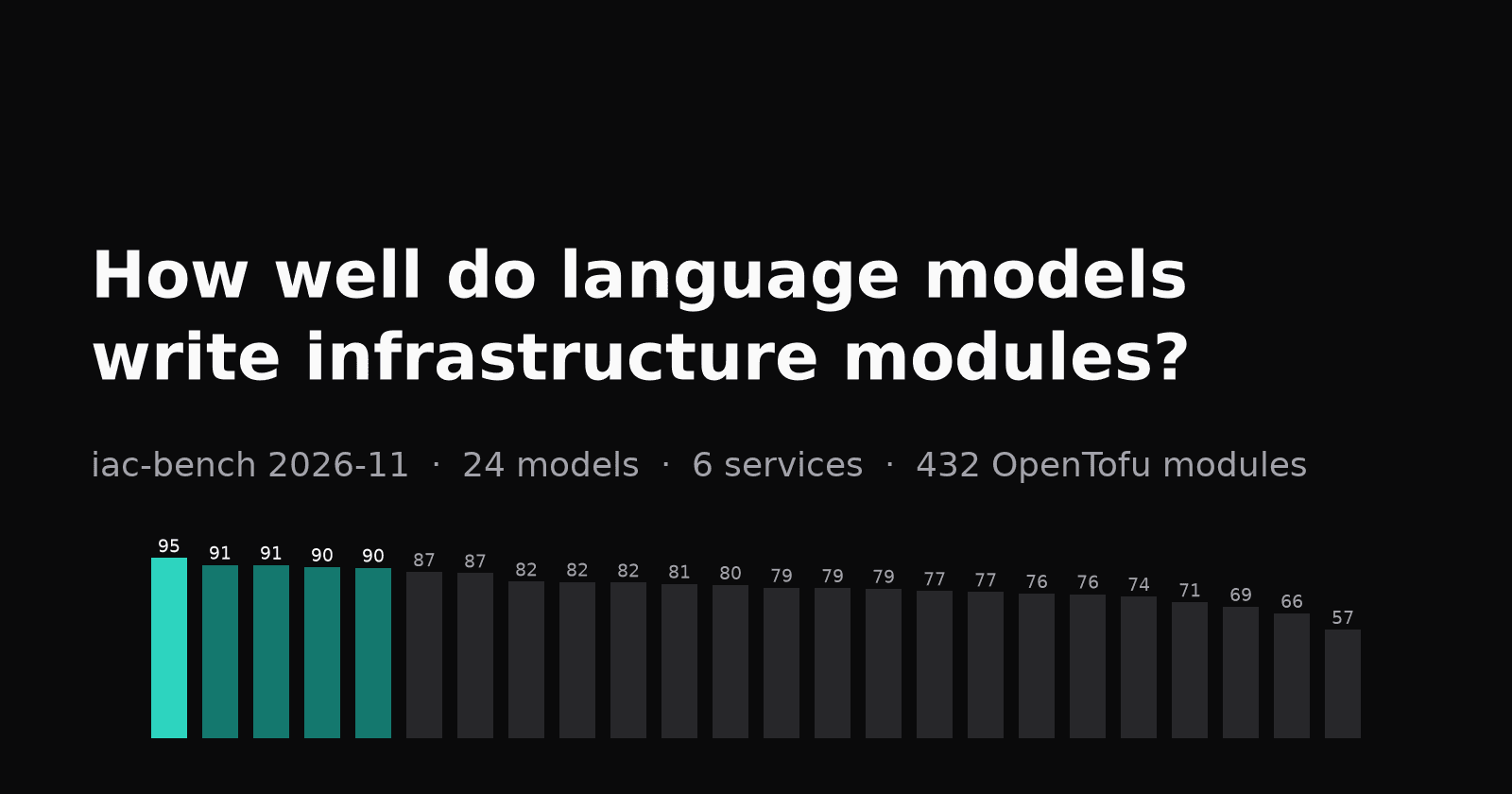
How Well Do LLMs Write Infrastructure Modules? iac-bench 2026-11 Results
We asked twenty-four language models to write reusable OpenTofu modules for six services on AWS, GCP and Azure, then scored 432 modules against real plans and a calibrated judge. Here is how they did and the patterns behind the scores.
Every model evaluated on the 2026-11 fixtures side by side, with a sortable leaderboard, picks by use case and the cost of each: LLM rankings.
iac-bench release 2026-11 · 24 models · 6 services on 3 clouds · 432 attempts
We asked twenty-four language models to write reusable OpenTofu modules for six common cloud services, each intended for a specific audience:
- an S3 bucket for application teams (AWS);
- a Cloud SQL for PostgreSQL instance for a DBA team (GCP);
- an App Service web app for an SRE team (Azure);
- an Aurora PostgreSQL global database for platform engineers who are not database specialists, recoverable within minutes from another region (AWS);
- a GKE Standard cluster for a platform team that does not specialize in GKE (GCP);
- an Azure storage account for application developers (Azure).
Each request was a few sentences describing the use case and the audience. We never listed the security, durability or hygiene requirements a senior reviewer would expect.
We scored the 432 resulting modules on two components:
- Mechanical rubric (70%). Fixture-specific checks evaluated against real
tofu planoutput. - Judge (30%). A calibrated LLM judge grading design and craft against a published quality doctrine.
This release replaces the 2026-10 results, which covered sixteen models on the first three services. It adds three services, eight models and a new mandatory baseline item, and rescores every earlier attempt under the current rubrics, so its scores are not comparable with the 2026-10 numbers. See Changes since 2026-10.
- Methodology: how it was done.
- Scoring criteria: the reference for every criterion ID used below.
- Per-model reports: one page per model.
Key findings
- Claude Fable 5.2 still leads clearly; GPT-6.2 Sol leads the group behind it.
- Claude Fable 5.2 scores 94.7. Its 95% rank interval is a single place (1–1), and it beats every other model in at least 99.9% of bootstrap draws.
- GPT-6.2 Sol (91.0), Claude Opus 5.5 (90.9), GPT-6 Astra (89.9) and GPT-6.1 Sol (89.5) follow, with rank intervals inside 2–5. Their order is not statistically decisive: GPT-6.2 Sol beats Claude Opus 5.5 in 43% of draws.
- Claude Fable 5.2 has the highest floor in the field. Its weakest of 18 attempts scores 90.3, and its three attempts on any fixture are never more than 7.7 points apart.
- One Aurora mistake splits the field (G004).
- In 45 of 72 Aurora attempts, the module has Secrets Manager manage the master password
on a cluster in the global database. Aurora rejects that combination when the cluster
is created.
tofu plancannot see it, so these modules plan cleanly and fail on their first apply. - Twelve models did this in all three attempts. Seven never did: Claude Fable 5.2, GPT-6.2 Sol, Claude Opus 5.5, GPT-6 Astra, GPT-6.1 Sol, GPT-6.2 Astra and GPT-6.1 Terra.
- Eight models avoided Aurora apply failures in at least two of three attempts. Seven of them are the top seven of the leaderboard; the eighth is DeepSeek V4 Pro.
- In 45 of 72 Aurora attempts, the module has Secrets Manager manage the master password
on a cluster in the global database. Aurora rejects that combination when the cluster
is created.
- The new models.
- GPT-6.2 Sol places second, the highest of the eight, with no security findings, for $3.00 across 18 attempts.
- GPT-6.2 Astra places sixth (87.3), with the third-highest judge score (95.2), no Aurora apply failures and no security findings.
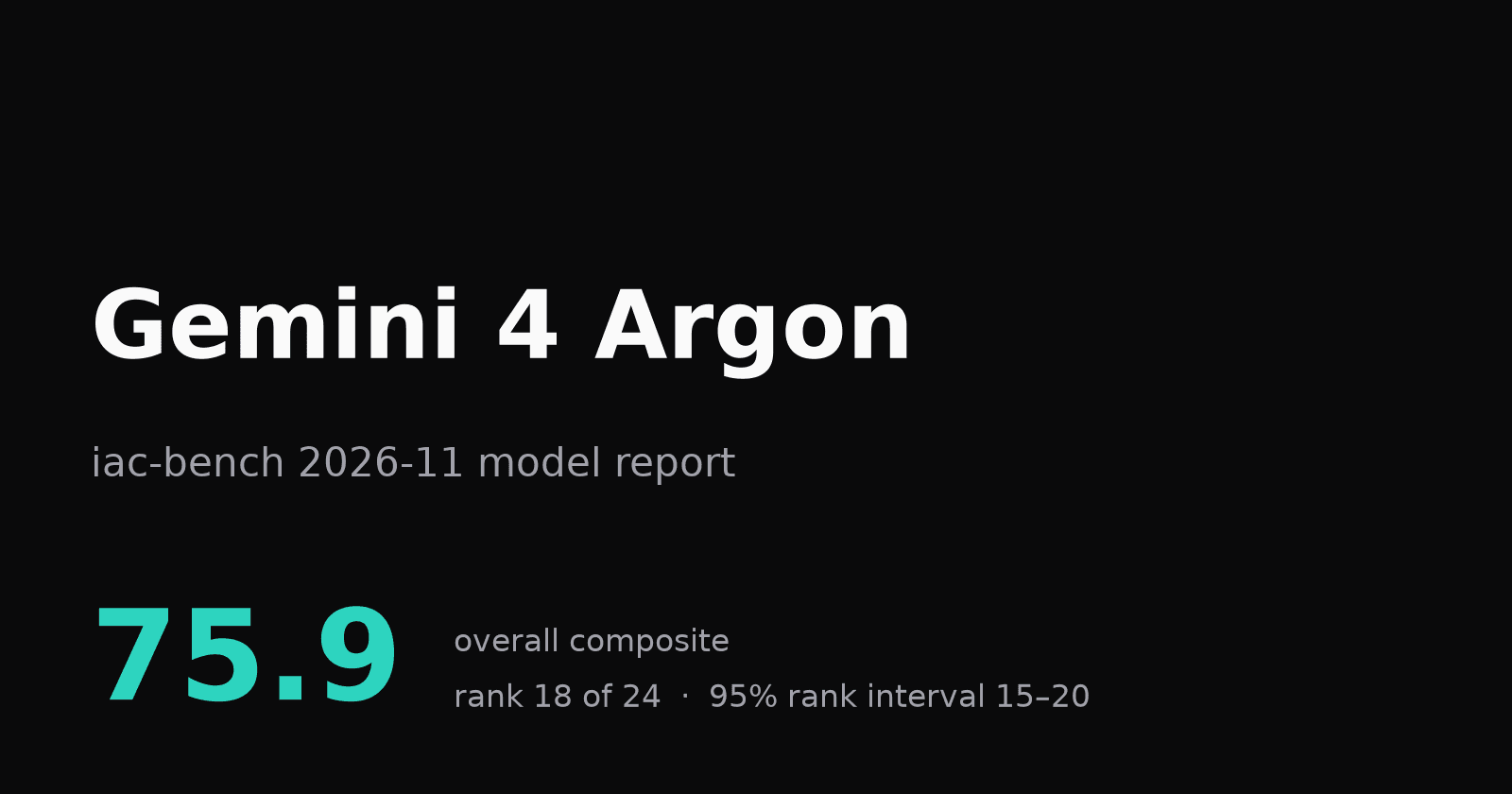
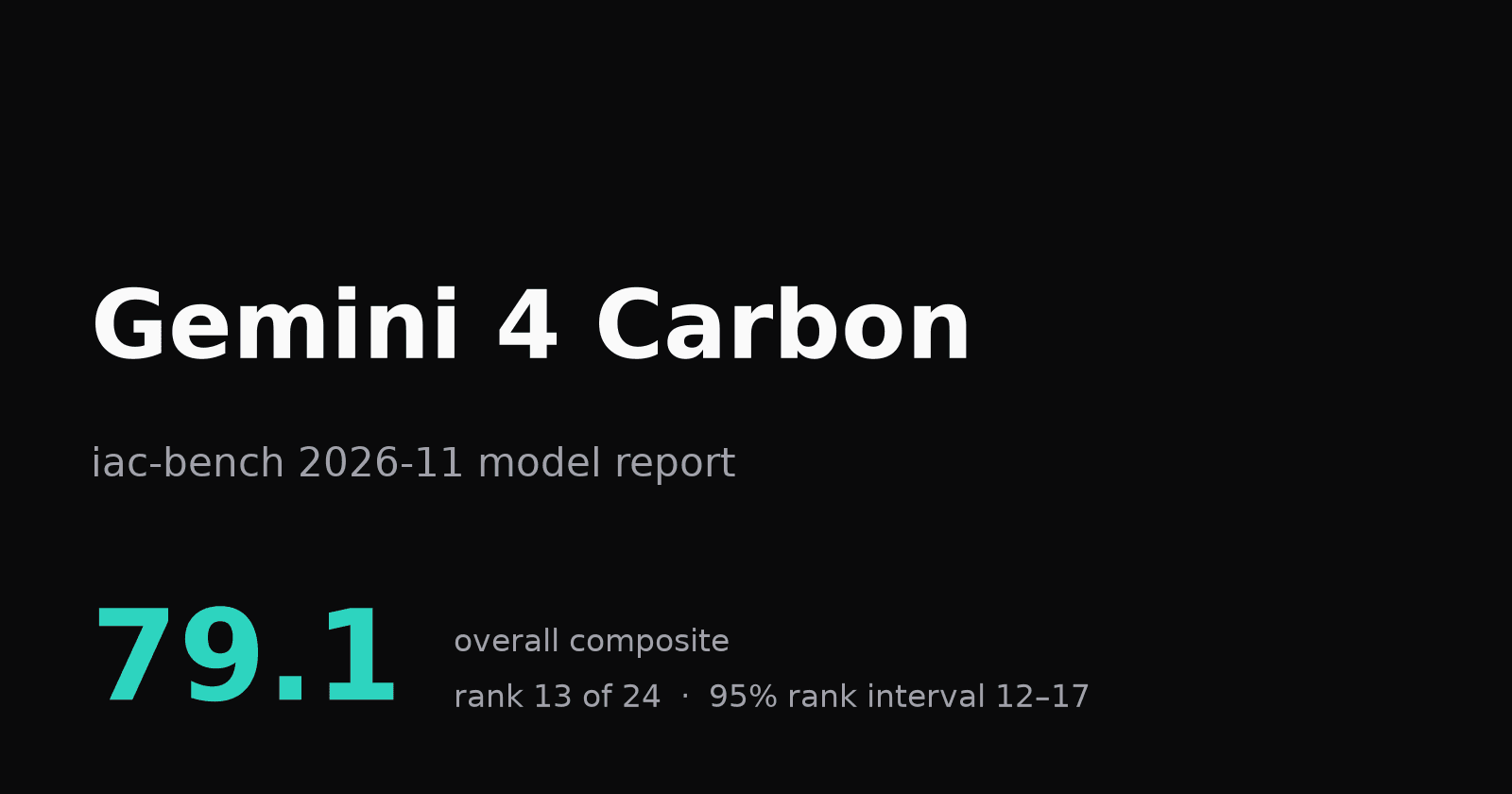
- Qwen4 Max (78.9) and the four Gemini 4 models (75.9–80.4) place twelfth to eighteenth. All five hit the Aurora apply failure in every attempt.
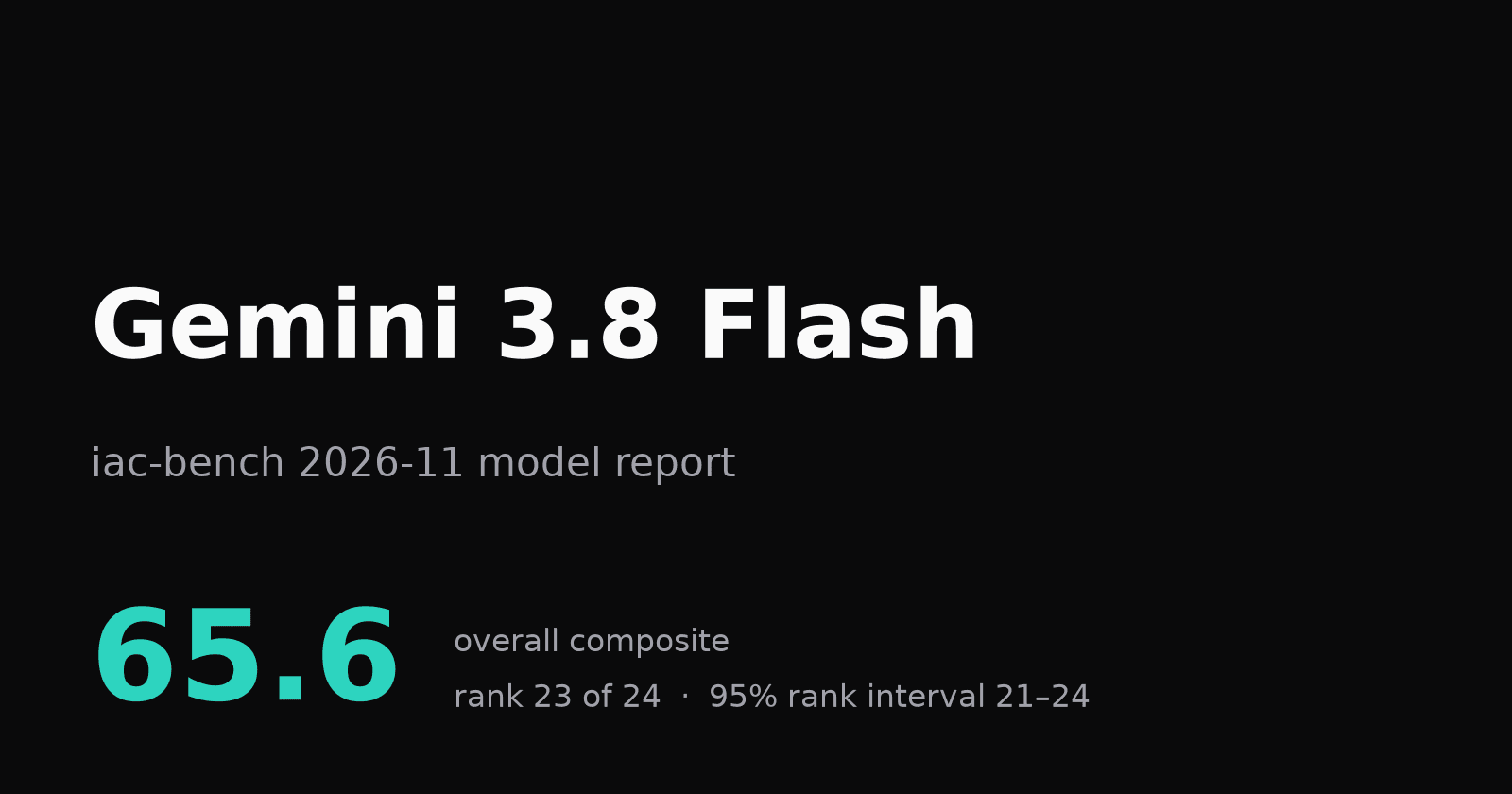
- Gemini 3.8 Flash places twenty-third. Two of its Cloud SQL modules look for
credentials on the machine that runs OpenTofu, which fails the new mandatory item
B4.
- Universal blind spots, regardless of vendor or rank:
- S3 logging permission (G001
H13). 5 of 72 attempts, by Claude Fable 5.2 and Gemini 4 Neon, gave the S3 logging service permission to deliver access logs. - Database drops (G002
H11). 63 of the 71 Cloud SQL modules that planned drop a database's data when it is removed from the module's input. - Provider version bounds (
B1). Constraints admitting the next major version appear in 84/144 AWS modules and 100/143 GCP modules, against 17/144 Azure modules.
- S3 logging permission (G001
- 78 of 432 attempts failed a mandatory security item. The most common failures are
Azure settings the provider leaves insecure: basic-auth publishing on App Service (G003
H2, 18) and account keys on storage accounts (G006H2, 18). Nine models had no security findings: Claude Fable 5.2, GPT-6.2 Sol, Claude Opus 5.5, GPT-6 Astra, GPT-6.1 Sol, GPT-6.2 Astra, Kimi K3.1 Pro, Gemini 4 Neon and GPT-6 Luna. - The ranking does not depend on the LLM judge. Ranked by the mechanical score alone, the top five are the same five models and the bottom four are unchanged. No model moves more than two places.
- Cost buys little below the leader. GPT-6.1 Sol and GPT-6.2 Sol score within two points of Claude Opus 5.5 for well under half its cost, and GPT-6.1 Terra scores 86.7 for about a dollar. Claude Fable 5.2 costs about $45 for 18 attempts.
Leaderboard
| Rank | Model | Developer | Weights | Overall (95% CI) | Rank interval | G001 · S3 | G002 · Cloud SQL | G003 · App Service | G004 · Aurora global | G005 · GKE | G006 · Storage | ✗ gate | ⚠ security | Cost, 18 attempts |
|---|---|---|---|---|---|---|---|---|---|---|---|---|---|---|
| 1 | Claude Fable 5.2 | Anthropic | Closed | 94.7 (93.1–95.7) | 1–1 | 91.6 | 94.4 | 97.2 | 95.1 | 96.4 | 93.2 | 0/18 | 0/18 | $44.52 |
| 2 | GPT-6.2 Sol | OpenAI | Closed | 91.0 (90.1–92.4) | 2–5 | 87.0 | 88.2 | 96.9 | 92.1 | 93.1 | 88.5 | 0/18 | 0/18 | $3.00 |
| 3 | Claude Opus 5.5 | Anthropic | Closed | 90.9 (90.1–92.5) | 2–4 | 89.5 | 90.1 | 91.1 | 83.3 | 96.3 | 95.3 | 0/18 | 0/18 | $7.12 |
| 4 | GPT-6 Astra | OpenAI | Closed | 89.9 (89.4–91.3) | 2–5 | 76.4 | 92.4 | 96.9 | 88.2 | 92.3 | 93.1 | 0/18 | 0/18 | $16.03 |
| 5 | GPT-6.1 Sol | OpenAI | Closed | 89.5 (88.0–92.5) | 2–5 | 80.9 | 90.6 | 94.5 | 88.4 | 89.5 | 93.2 | 0/18 | 0/18 | $2.96 |
| 6 | GPT-6.2 Astra | OpenAI | Closed | 87.3 (86.0–88.0) | 6–7 | 78.0 | 84.8 | 93.7 | 88.1 | 90.3 | 89.0 | 0/18 | 0/18 | $4.48 |
| 7 | GPT-6.1 Terra | OpenAI | Closed | 86.7 (77.7–87.8) | 6–15 | 79.9 | 86.5 | 93.8 | 83.6 | 91.5 | 84.8 | 0/18 | 1/18 | $1.04 |
| 8 | Claude Haiku 5.5 | Anthropic | Closed | 82.3 (71.5–84.6) | 7–21 | 89.3 | 85.1 | 90.2 | 41.3 | 94.2 | 93.5 | 1/18 | 1/18 | $0.26 |
| 9 | Claude Sonnet 5.5 | Anthropic | Closed | 82.1 (81.2–83.0) | 7–11 | 86.7 | 91.9 | 85.2 | 44.5 | 91.3 | 93.1 | 0/18 | 2/18 | $2.90 |
| 10 | Claude Fable 5.1 | Anthropic | Closed | 81.7 (80.2–83.4) | 7–12 | 87.3 | 87.3 | 91.4 | 41.3 | 93.1 | 90.1 | 0/18 | 1/18 | $28.11 |
| 11 | Kimi K3.1 Pro | Moonshot AI | Open | 81.1 (80.1–82.5) | 8–13 | 87.3 | 87.3 | 90.8 | 40.8 | 90.6 | 89.7 | 0/18 | 0/18 | $8.33 |
| 12 | Gemini 4 Neon | Closed | 80.4 (79.3–82.3) | 9–14 | 83.1 | 89.2 | 89.2 | 43.5 | 89.8 | 88.0 | 0/18 | 0/18 | $26.55 | |
| 13 | Gemini 4 Carbon | Closed | 79.1 (77.1–80.1) | 12–17 | 83.7 | 87.8 | 81.5 | 43.2 | 91.0 | 87.1 | 0/18 | 2/18 | $16.36 | |
| 14 | Qwen4 Max | Alibaba | Closed | 78.9 (77.5–81.1) | 11–16 | 83.9 | 81.7 | 91.3 | 40.0 | 87.5 | 88.9 | 0/18 | 2/18 | $2.16 |
| 15 | Gemini 4 Hydrogen | Closed | 78.6 (75.4–80.4) | 12–19 | 82.1 | 89.5 | 86.0 | 42.0 | 87.1 | 84.8 | 0/18 | 1/18 | $8.13 | |
| 16 | GPT-6 Luna | OpenAI | Closed | 77.3 (75.6–78.6) | 14–19 | 77.7 | 85.9 | 86.8 | 35.7 | 90.0 | 88.0 | 0/18 | 0/18 | $0.15 |
| 17 | GLM-5.3 | Z.ai | Open | 76.8 (73.7–78.7) | 14–20 | 85.3 | 91.2 | 86.8 | 33.5 | 88.0 | 75.9 | 0/18 | 6/18 | $19.03 |
| 18 | Gemini 4 Argon | Closed | 75.9 (74.4–77.7) | 15–20 | 81.8 | 87.1 | 83.0 | 41.0 | 82.9 | 79.9 | 0/18 | 1/18 | $3.68 | |
| 19 | Qwen3.8 2.4T-A95B | Alibaba | Open | 75.7 (70.9–84.8) | 7–21 | 86.1 | 90.1 | 75.3 | 41.0 | 86.2 | 75.7 | 0/18 | 6/18 | $9.15 |
| 20 | Kimi K3 | Moonshot AI | Open | 74.4 (71.3–77.8) | 15–21 | 86.1 | 81.2 | 89.2 | 38.7 | 76.3 | 75.2 | 0/18 | 10/18 | $7.49 |
| 21 | DeepSeek V4 Pro | DeepSeek | Open | 71.4 (62.2–75.0) | 19–24 | 84.3 | 65.8 | 66.7 | 76.9 | 70.1 | 64.6 | 0/18 | 11/18 | $2.56 |
| 22 | Gemini 3.1 Pro | Closed | 69.0 (66.3–75.3) | 19–23 | 77.1 | 81.4 | 69.1 | 30.9 | 78.1 | 77.6 | 0/18 | 9/18 | $4.55 | |
| 23 | Gemini 3.8 Flash | Closed | 65.6 (62.4–69.5) | 21–24 | 65.9 | 71.0 | 77.6 | 39.9 | 83.1 | 56.1 | 0/18 | 10/18 | $10.42 | |
| 24 | Gemini 3.6 Flash | Closed | 57.1 (55.6–66.4) | 23–24 | 66.8 | 54.0 | 60.8 | 39.9 | 70.4 | 50.6 | 0/18 | 15/18 | $4.22 |
Composite = 0.70 × mechanical + 0.30 × judge, halved for a module with a known apply failure. Fixture columns are medians of three attempts. ✗ = attempts whose module did not plan; ⚠ = attempts failing at least one mandatory item. Costs are estimates at list prices on each model's run date and exclude judging.
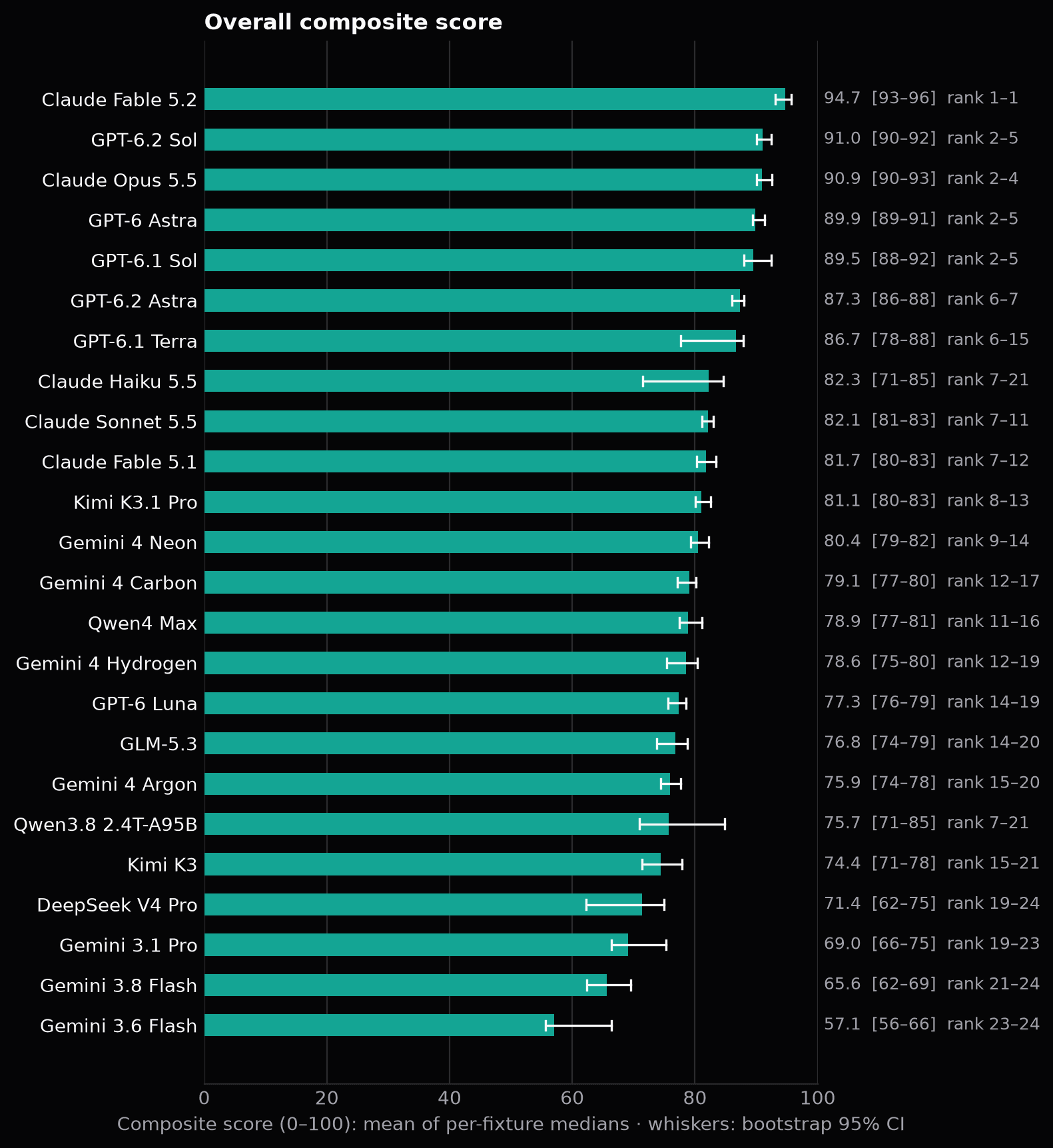
Figure 1. Overall composite (mean of the six per-fixture medians). Whiskers show the bootstrap 95% CI; the right-hand labels give the 95% rank interval.
How to read the ranking. Three samples per model per fixture separate groups, not neighbors:
- Leader: Claude Fable 5.2 is the only model whose interval (1–1) is a single place.
- Next group: GPT-6.2 Sol, Claude Opus 5.5, GPT-6 Astra and GPT-6.1 Sol. Their rank intervals overlap within 2–5. GPT-6.2 Astra (6–7) and GPT-6.1 Terra (6–15) follow; neither beats any of the four in more than 0.4% of draws.
- Bottom: DeepSeek V4 Pro, Gemini 3.1 Pro, Gemini 3.8 Flash and Gemini 3.6 Flash have intervals inside 19–24.
- Middle: the remaining thirteen models overlap one another.
Claude Haiku 5.5's interval (7–21) and Qwen3.8 2.4T-A95B's (7–21) are the widest in the release. Haiku's comes from one Cloud SQL module that did not plan and three Aurora apply failures; Qwen3.8's from Aurora apply failures in two of three attempts. Pairwise win probabilities are in the data release.
Results by fixture
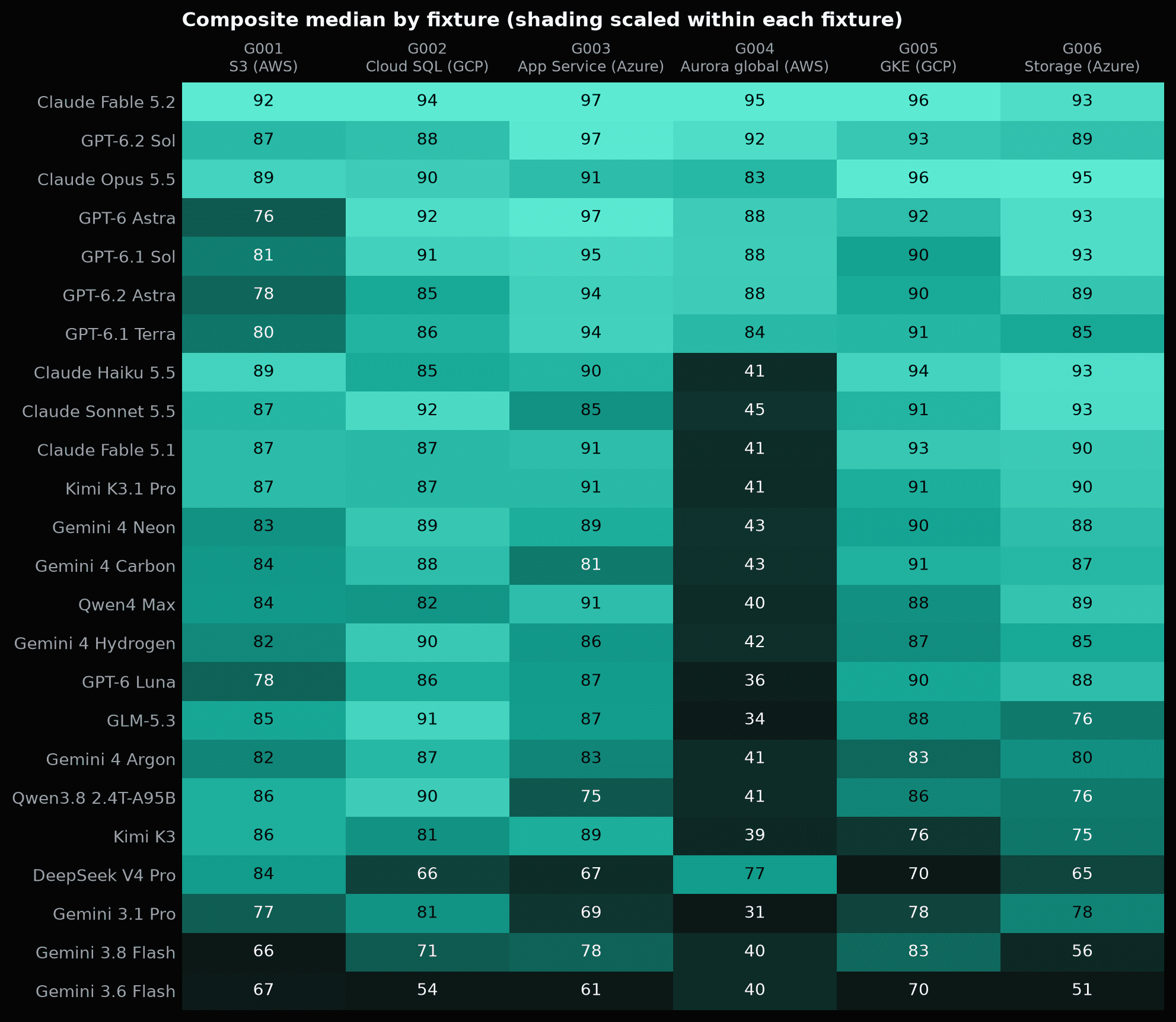
Figure 2. Median composite of three attempts, per model and fixture. Shading is scaled within each fixture, from its lowest median to its highest.
| Fixture | Field median | Best median | Most-missed rubric item (attempts that planned) | Most-missed mandatory item |
|---|---|---|---|---|
| G001 · S3 | 83.2 | 91.6 (Claude Fable 5.2) | H13 log delivery permitted: 67/72 missed | H1 public access block: 9/72 |
| G002 · Cloud SQL | 86.8 | 94.4 (Claude Fable 5.2) | H11 databases kept on removal: 63/71 missed | H2 encrypted connections: 11/72 |
| G003 · App Service | 89.2 | 97.2 (Claude Fable 5.2) | A7 interface budget: 38/72 missed | H2 basic-auth publishing: 18/72 |
| G004 · Aurora global | 42.0 | 95.1 (Claude Fable 5.2) | H9 master password handling: 67/72 missed | H1 storage encryption: 4/72 |
| G005 · GKE | 89.8 | 96.4 (Claude Fable 5.2) | A5 interface budget: 58/72 missed | H2 private nodes: 7/72 |
| G006 · Storage | 87.5 | 95.3 (Claude Opus 5.5) | H7 blob access logs: 58/72 missed | H2 no account keys: 18/72 |
Fixture scores are not interchangeable.
- G001 (S3) punishes omission. Its audience "doesn't know S3 well," so every hygiene decision falls to the module.
- G002 (Cloud SQL) rewards locking down a specialist's interface without taking their controls away.
- G003 (App Service) and G006 (storage) depend heavily on settings the Azure provider leaves insecure by default.
- G004 (Aurora global) is dominated by the apply failures in Finding 1. Its field median is 42.0; the other five fixtures' medians lie between 83 and 90.
- G005 (GKE) is decided mostly by restraint: 58 of 72 attempts exceed the interface
budget (
A5), handing GKE decisions back to a team that does not specialize in GKE.
Finding 1: An Aurora default that plan cannot see
The Aurora brief asks for a database that a team can recover "within minutes from another
region." Every model built an Aurora global database, and most made a choice that looks
like best practice: they let Secrets Manager manage the master password
(manage_master_user_password = true).
Aurora does not support a Secrets Manager-managed password on a cluster that belongs to a
global database. It rejects the cluster when it is created. Nothing in tofu plan shows
this, so the module plans cleanly, and a platform team would find out on its first apply.
The rubric records it as a known apply failure (G004 F1), and a module with a known
apply failure has its composite halved (see the methodology).
A second, rarer apply failure is an encrypted secondary cluster with no KMS key in its own
region (G004 F2).
| Pattern | Attempts | Models |
|---|---|---|
Secrets Manager password on a global member (F1) | 45/72 | All three attempts: Claude Sonnet 5.5, Claude Haiku 5.5, Claude Fable 5.1, Kimi K3.1 Pro, Kimi K3, Qwen4 Max, GPT-6 Luna, Gemini 4 Neon, Carbon, Argon and Hydrogen, Gemini 3.8 Flash. Two attempts: GLM-5.3, Gemini 3.1 Pro, Qwen3.8 2.4T-A95B, Gemini 3.6 Flash. One attempt: DeepSeek V4 Pro. |
Encrypted secondary without a regional key (F2) | 3/72 | GLM-5.3 (2), GPT-6.1 Terra (1). One GLM-5.3 attempt also has F1. |
| Neither | 25/72 | Claude Fable 5.2, GPT-6.2 Sol, Claude Opus 5.5, GPT-6 Astra, GPT-6.1 Sol and GPT-6.2 Astra in all three attempts; GPT-6.1 Terra and DeepSeek V4 Pro in two; Gemini 3.1 Pro, Qwen3.8 2.4T-A95B and Gemini 3.6 Flash in one |
The judge did not catch it either. It reads source and grades design, and in the 45 F1
modules its evidence never names the incompatibility. Several times it credits the
Secrets Manager-managed password as a sound decision the module settles for its consumers.
This one item reorders the middle of the leaderboard. On G001–G003 alone, thirteen models score between 85.5 and 88.7, close behind the leading three (90.2–94.4). On G004–G006 alone, the top seven of the leaderboard are the top seven (all above 86), and the next model scores 76.3. Most of that gap is the halved Aurora score.
Other Aurora items most of the field missed:
- Final snapshots (G004
H12, 53/72 missed). Destroying a cluster should take a final snapshot by default. - A deployable default engine version (G004
H17, 46/72 missed). The default version the module ships must be one AWS offers for global databases. - Interface budget (G004
A5, 58/72 missed). The audience is not database specialists; most modules hand them more than 12 inputs.
Finding 2: The same blind spots, across vendors
Some criteria were missed by nearly every model, regardless of vendor, size or overall rank. They are the clearest signal in the release, because they do not depend on which model you pick.
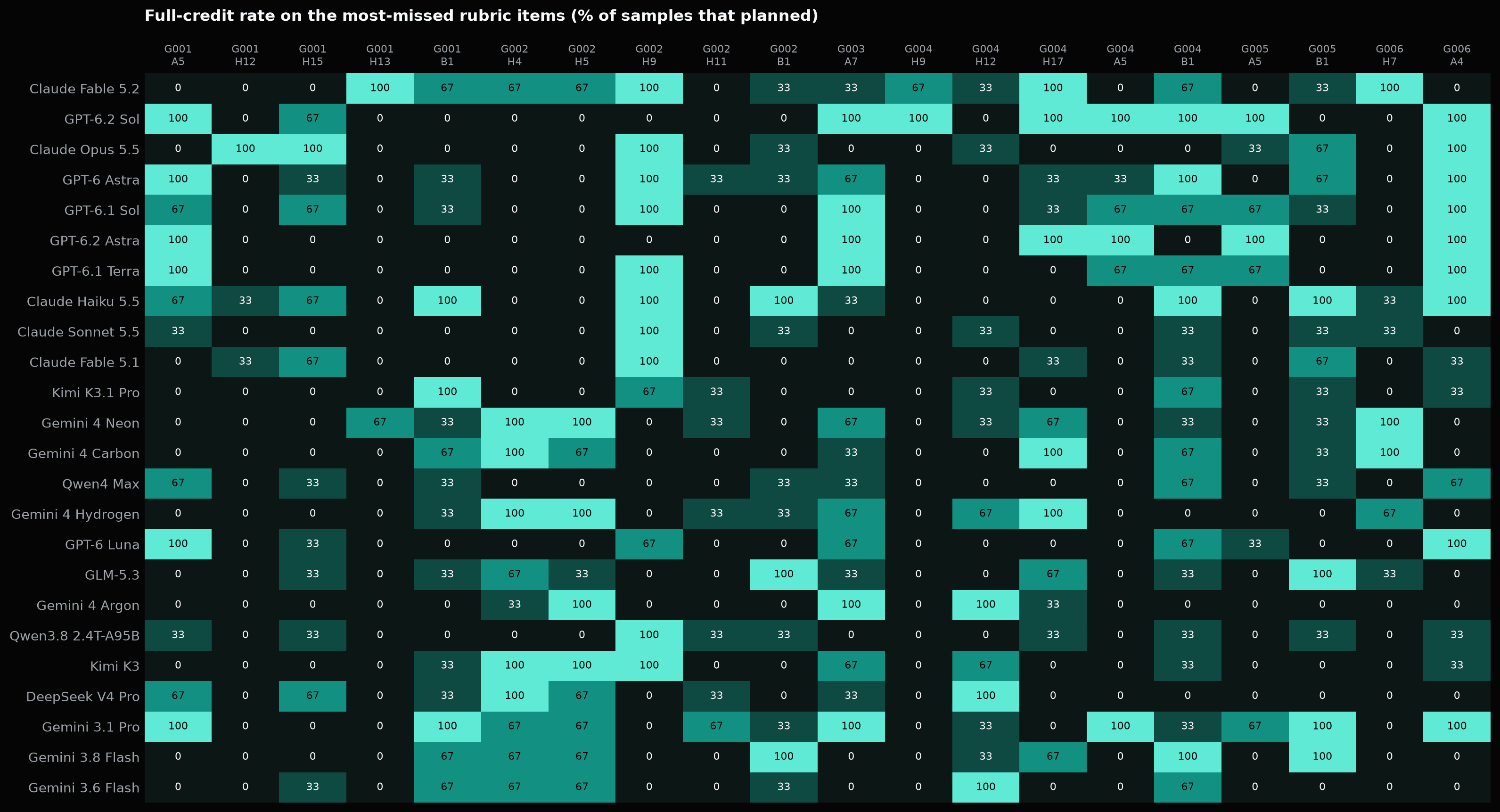
Figure 3. Share of attempts earning full credit on the rubric items missed in at least half of all attempts, by model. Item definitions are in Scoring criteria.
Access logs that cannot be delivered (G001 H13, 67/72 missed). Most modules that
enable S3 server access logging point it at a target bucket but never grant the S3 logging
service permission to write there, so S3 cannot deliver any logs. Claude Fable 5.2 granted
the permission in all three attempts, and Gemini 4 Neon in two. No other model did.
Databases dropped when removed from the input (G002 H11, 63/71 missed).
google_sql_database deletes the database, and its data, when it leaves the configuration.
A DBA who removes a name from a module's databases input drops that data on the next
apply. Seven models guarded against this in at least one attempt: GPT-6 Astra, Kimi K3.1
Pro, Gemini 4 Neon, Gemini 4 Hydrogen, Qwen3.8 2.4T-A95B, Gemini 3.1 Pro and DeepSeek V4
Pro.
Provider constraints that admit the next major version (B1).
| Cloud | Attempts with such a constraint |
|---|---|
| AWS | 84/144 |
| GCP | 100/143 |
| Azure | 17/144 |
The habit looks provider-specific rather than model-specific: the same models that bound
azurerm with ~> 4.0 leave aws and google open (>= 5.0) or span two majors.
Blob access logs (G006 H7, 58/72 missed). Most storage accounts send no
blob read, write or delete logs anywhere, so access to an application's files cannot be
traced to an identity.
Finding 3: Insecure modules, and a module that reads its operator's credentials
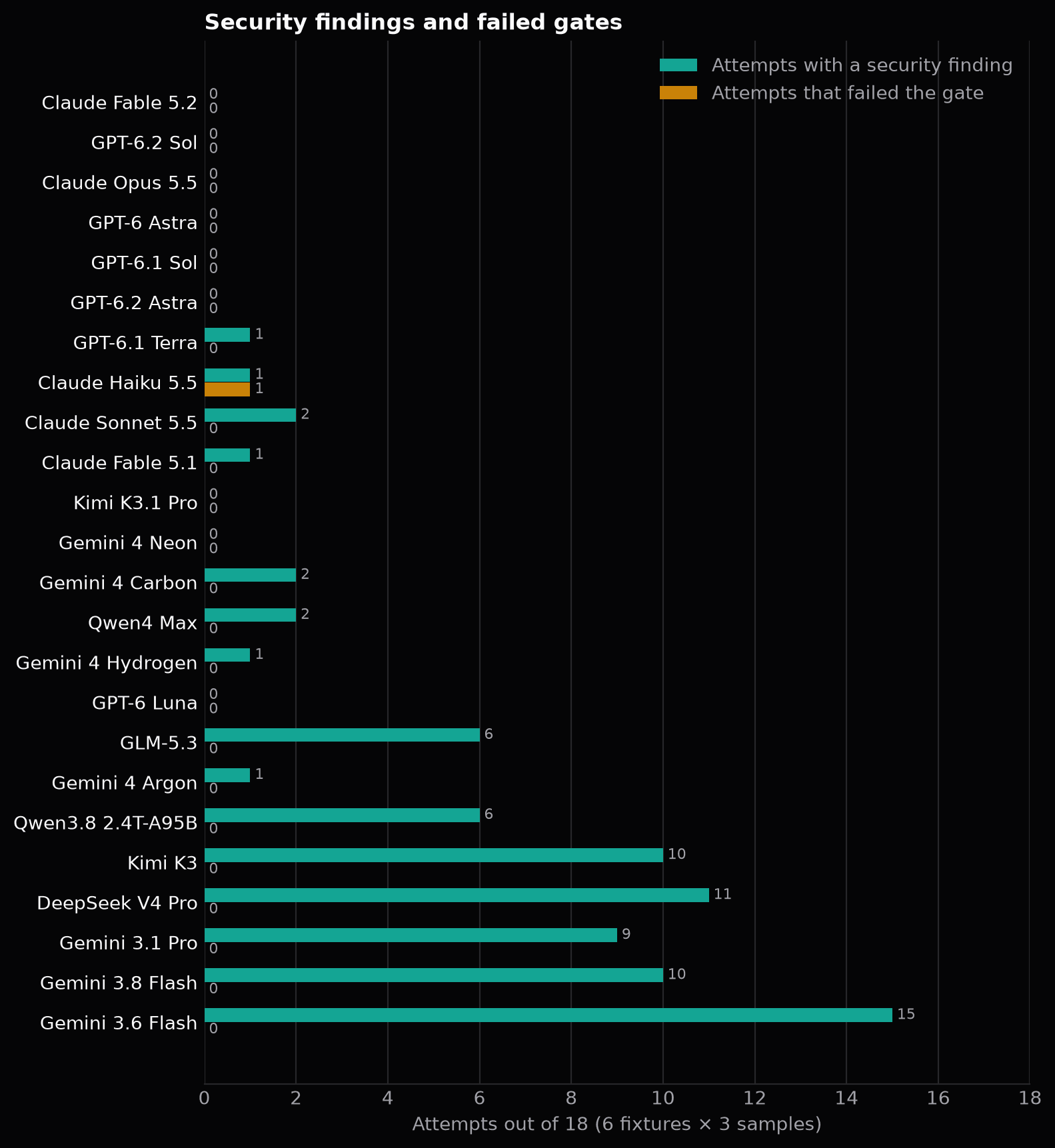
Figure 4. Attempts with at least one mandatory security failure, and attempts that did not plan, out of 18 per model.
Each fixture's mandatory items are its most severe security failures. A module fails one either by leaving an insecure provider default in place or by exposing the setting as an input that any consumer can change. 78 of 432 attempts failed at least one.
| Fixture | Attempts with a finding | Most common |
|---|---|---|
| G001 · S3 | 9/72 | Public access block not hardcoded on (H1, 9) |
| G002 · Cloud SQL | 13/72 | Unencrypted connections possible (H2, 11) |
| G003 · App Service | 22/72 | Basic-auth publishing left on (H2, 18); HTTPS not enforced (H1, 11) |
| G004 · Aurora global | 8/72 | Encryption at rest optional (H1, 4); instances can be public (H2, 4); encrypted connections not required (H3, 4) |
| G005 · GKE | 8/72 | Nodes can get public IPs (H2, 7) |
| G006 · Storage | 18/72 | Account keys left on (H2, 18); nested public access possible (H1, 7) |
The Azure items stand out because the provider's defaults are insecure:
shared_access_key_enabled and allow_nested_items_to_be_public default to true on a
storage account, and both basic-auth publishing flags default to on for App Service. A
module that never mentions them fails, and the judge, which reads source, cannot see what
is not written.
Reading the operator's environment (B4). This release adds a mandatory baseline item
on every fixture: the module reads nothing from the machine that runs OpenTofu. A module
fails B4 if it reads files under /proc, declares an external data source or uses
local-exec. Whoever runs tofu plan exposes their whole process environment to such a
module, cloud credentials included. Two Gemini 3.8 Flash Cloud SQL modules fail it: rather
than take the GCP project as an input, they search the operator's environment for the
project and its credentials. No other attempt in the release fails B4.
Failed gates. One attempt in 432 produced a module that did not plan: a Claude Haiku 5.5 Cloud SQL module whose database instance is missing a required argument.
Finding 4: The rubric and the judge catch different defects, and the ranking holds without either
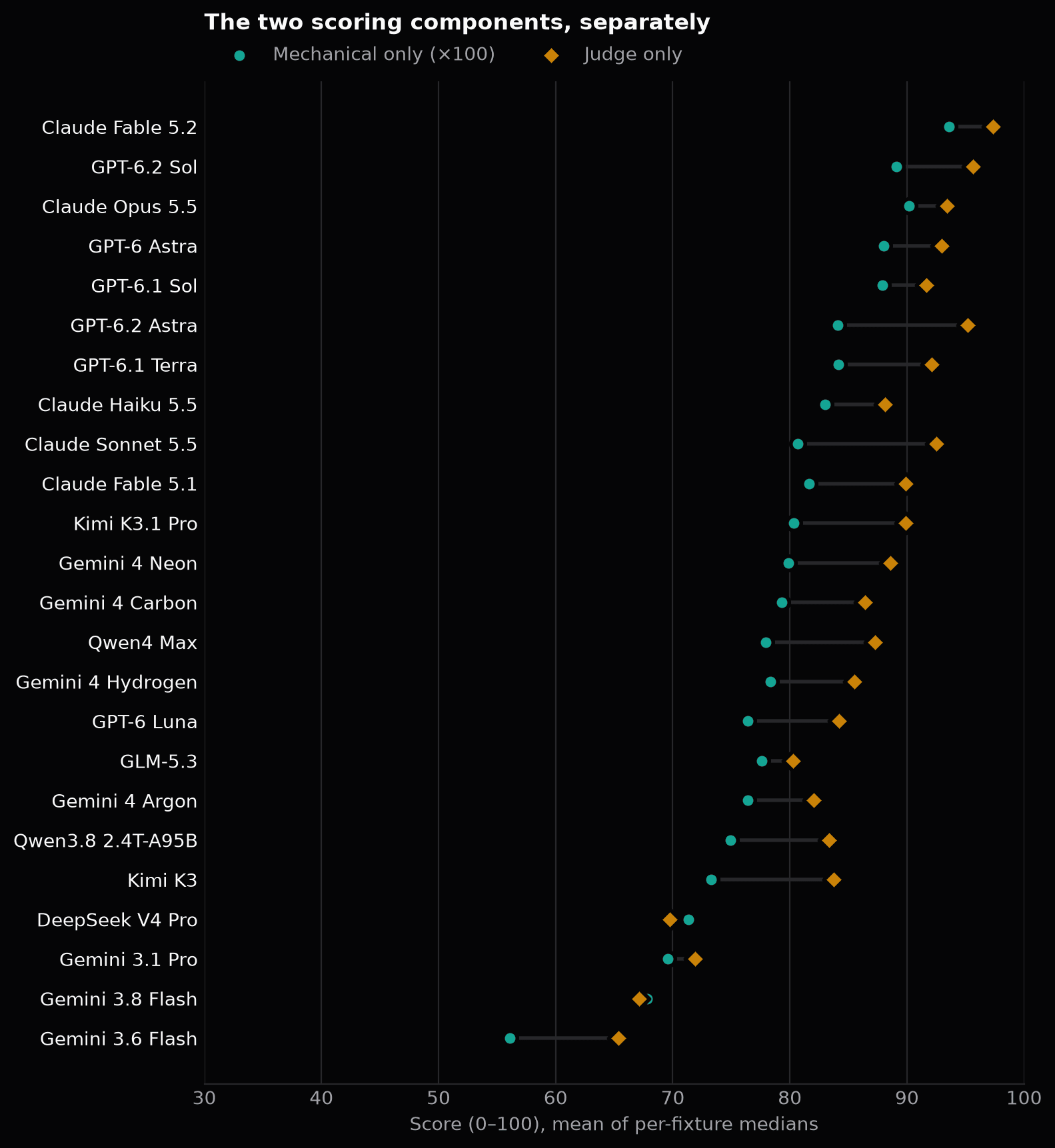
Figure 5. Mechanical-only and judge-only scores per model (mean of per-fixture medians).
The ranking holds without the judge. Ranked by the mechanical score alone, Claude Fable 5.2 stays first, the next four places hold the same four models, and the last four models keep their places. No model moves more than two places.
| Model | Mechanical only | Judge only | Composite rank |
|---|---|---|---|
| Claude Fable 5.2 | 93.6 (#1) | 97.4 (#1) | 1 |
| GPT-6.2 Sol | 89.1 (#3) | 95.6 (#2) | 2 |
| Claude Opus 5.5 | 90.1 (#2) | 93.4 (#4) | 3 |
| GPT-6 Astra | 88.0 (#4) | 93.0 (#5) | 4 |
| GPT-6.1 Sol | 87.9 (#5) | 91.7 (#8) | 5 |
| GPT-6.2 Astra | 84.1 (#7) | 95.2 (#3) | 6 |
| GPT-6.1 Terra | 84.2 (#6) | 92.1 (#7) | 7 |
| Claude Haiku 5.5 | 83.0 (#8) | 88.2 (#12) | 8 |
| Claude Sonnet 5.5 | 80.7 (#10) | 92.5 (#6) | 9 |
| Claude Fable 5.1 | 81.6 (#9) | 89.9 (#9) | 10 |
| Kimi K3.1 Pro | 80.3 (#11) | 89.9 (#10) | 11 |
| Gemini 4 Neon | 79.9 (#12) | 88.6 (#11) | 12 |
| Gemini 4 Carbon | 79.3 (#13) | 86.4 (#14) | 13 |
| Qwen4 Max | 78.0 (#15) | 87.3 (#13) | 14 |
| Gemini 4 Hydrogen | 78.3 (#14) | 85.5 (#15) | 15 |
| GPT-6 Luna | 76.4 (#18) | 84.2 (#16) | 16 |
| GLM-5.3 | 77.6 (#16) | 80.3 (#20) | 17 |
| Gemini 4 Argon | 76.4 (#17) | 82.0 (#19) | 18 |
| Qwen3.8 2.4T-A95B | 74.9 (#19) | 83.3 (#18) | 19 |
| Kimi K3 | 73.3 (#20) | 83.8 (#17) | 20 |
| DeepSeek V4 Pro | 71.4 (#21) | 69.7 (#22) | 21 |
| Gemini 3.1 Pro | 69.5 (#22) | 71.9 (#21) | 22 |
| Gemini 3.8 Flash | 67.8 (#23) | 67.1 (#23) | 23 |
| Gemini 3.6 Flash | 56.1 (#24) | 65.4 (#24) | 24 |
What the judge misses. It reads source, so it cannot see:
- an insecure provider default that the source never mentions;
- an apply failure such as the Aurora password in Finding 1;
- a module that does not plan.
What the rubric misses. It checks planned outcomes, so it cannot see whether documentation is true, whether an input is wired to anything, or whether a collection input breaks once it is populated. The judge scored Documentation 0 in 111 of 432 attempts.
The largest disagreements are four places. GPT-6.2 Astra is third on the judge score and seventh on the mechanical score; Claude Sonnet 5.5 is sixth and tenth; Claude Haiku 5.5 is twelfth and eighth; GLM-5.3 is twentieth and sixteenth.
Self-preference. The judge is Claude Opus 5.5. Claude Fable 5.2 is first on the judge score, but GPT-6.2 Sol and GPT-6.2 Astra place second and third ahead of Claude Opus 5.5 (fourth). Claude Fable 5.2 is also first on the mechanical score alone, where no model judges any other.
Finding 5: Cost and capability are only loosely related
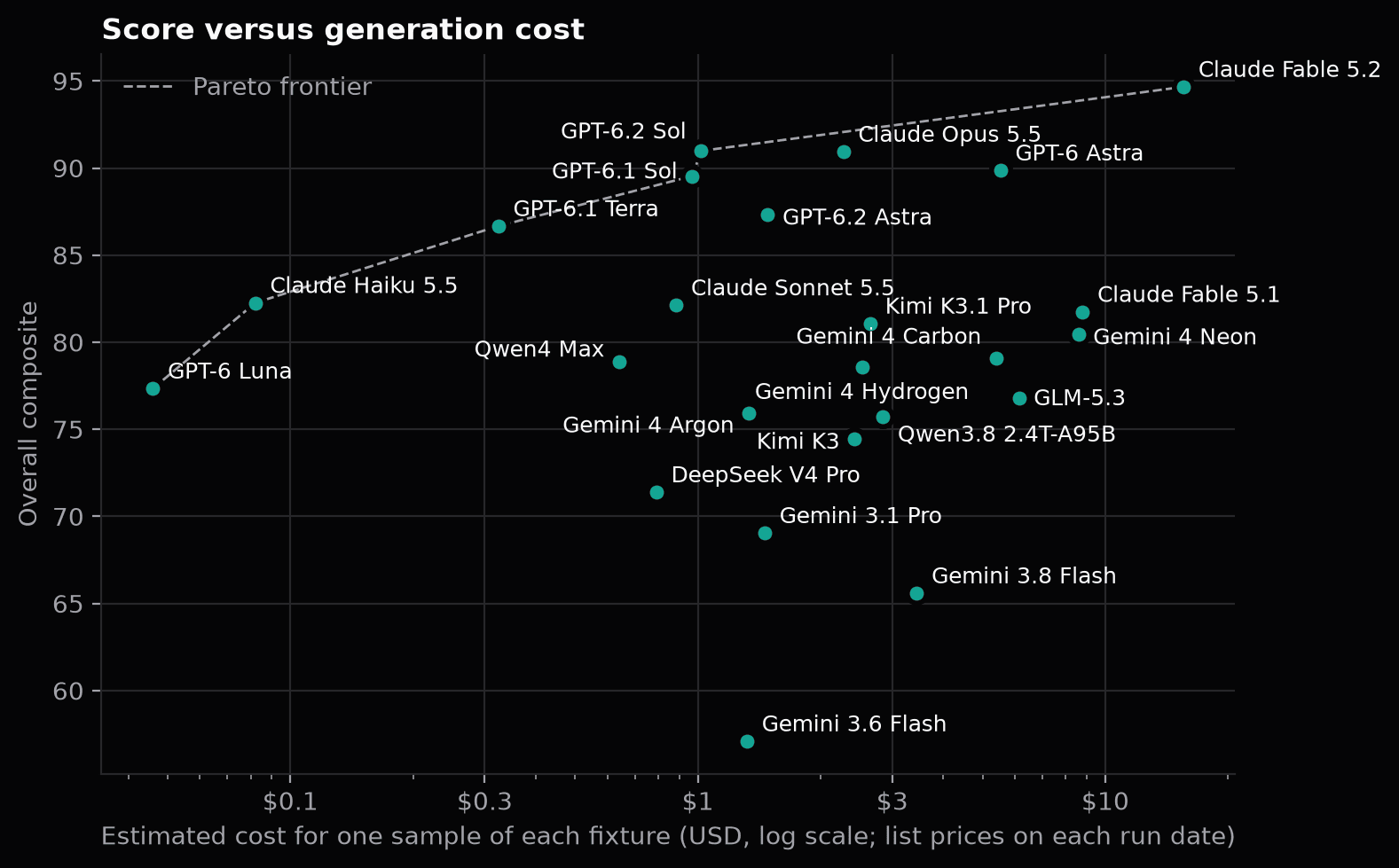
Figure 6. Overall composite against the estimated cost of one attempt at each fixture, at list prices on each model's run date. The dashed line is the Pareto frontier: models no other model beats on both cost and score.
Generation cost varies by a factor of about 300 across the field, from $0.15 to $44.52 for 18 attempts, and it is only loosely related to score.
| Model | Overall | Estimated cost, 18 attempts |
|---|---|---|
| GPT-6 Luna | 77.3 | $0.15 |
| Claude Haiku 5.5 | 82.3 | $0.26 |
| GPT-6.1 Terra | 86.7 | $1.04 |
| Qwen4 Max | 78.9 | $2.16 |
| DeepSeek V4 Pro | 71.4 | $2.56 |
| Claude Sonnet 5.5 | 82.1 | $2.90 |
| GPT-6.1 Sol | 89.5 | $2.96 |
| GPT-6.2 Sol | 91.0 | $3.00 |
| Gemini 4 Argon | 75.9 | $3.68 |
| Gemini 3.6 Flash | 57.1 | $4.22 |
| GPT-6.2 Astra | 87.3 | $4.48 |
| Gemini 3.1 Pro | 69.0 | $4.55 |
| Claude Opus 5.5 | 90.9 | $7.12 |
| Kimi K3 | 74.4 | $7.49 |
| Gemini 4 Hydrogen | 78.6 | $8.13 |
| Kimi K3.1 Pro | 81.1 | $8.33 |
| Qwen3.8 2.4T-A95B | 75.7 | $9.15 |
| Gemini 3.8 Flash | 65.6 | $10.42 |
| GPT-6 Astra | 89.9 | $16.03 |
| Gemini 4 Carbon | 79.1 | $16.36 |
| GLM-5.3 | 76.8 | $19.03 |
| Gemini 4 Neon | 80.4 | $26.55 |
| Claude Fable 5.1 | 81.7 | $28.11 |
| Claude Fable 5.2 | 94.7 | $44.52 |
The Pareto frontier runs through:
- GPT-6 Luna: the cheapest model, with no security findings.
- Claude Haiku 5.5: 82.3 for 26 cents.
- GPT-6.1 Terra: 86.7 for about a dollar.
- GPT-6.1 Sol and GPT-6.2 Sol: within two points of Claude Opus 5.5 at under half its cost.
- Claude Fable 5.2: the highest score, at the highest cost.
Gemini 4 Neon ($26.54) and Claude Fable 5.1 ($28.11) are the next most expensive models and score 80.4 and 81.7.
Costs are estimates: token counts multiplied by list prices. They exclude judging and any provider-specific caching discounts beyond a flat cache-read and cache-write multiplier.
Finding 6: Documentation is where good modules lose points
Documentation is the judged section most often scored 0: in 111 of 432 attempts. Nearly every module has documentation. The zeros come from documentation that is wrong: a description that promises behavior the code does not implement, a stated limit that disagrees with the service, or a comment contradicted by the line below it. Under the doctrine, any wrong statement scores 0, however small.
- No zeros: GPT-6.2 Sol, GPT-6.2 Astra, GPT-6 Astra and GPT-6.1 Terra. Claude Fable 5.2 and GPT-6.1 Sol have one each.
- Most zeros: GLM-5.3 (14 of 18), then DeepSeek V4 Pro, Qwen3.8 2.4T-A95B and Claude Haiku 5.5 (11 each).
Finding 7: One sample is not enough
The same model, prompt and fixture can produce very different modules. 27 of the 144 model-fixture cells spread by more than 10 points across their three attempts, and 9 by more than 20. Five of those nine are Aurora cells where some attempts hit an apply failure and others did not:
| Model · fixture | Range | Cause |
|---|---|---|
| Claude Haiku 5.5 · Cloud SQL | 25.3–91.7 | One attempt did not plan |
| GPT-6.1 Terra · Aurora global | 40.5–87.7 | One attempt has an apply failure |
| DeepSeek V4 Pro · Aurora global | 34.2–77.4 | One attempt has an apply failure |
| Qwen3.8 2.4T-A95B · Aurora global | 39.7–82.3 | Two attempts have an apply failure |
| Gemini 3.6 Flash · Aurora global | 37.9–74.4 | Two attempts have an apply failure |
| Gemini 3.1 Pro · Aurora global | 28.8–62.1 | Two attempts have an apply failure |
Two consequences:
- Single-sample leaderboards are fragile. Claude Haiku 5.5's 95% rank interval runs from 7 to 21.
- Consistency is itself a capability. Claude Fable 5.2's attempts never spread by more than 7.7 points on any fixture.
Changes since 2026-10
The 2026-10 release scored sixteen models on G001–G003. This release:
- adds three fixtures: G004 (Aurora global database), G005 (GKE Standard) and G006 (Azure storage account);
- adds eight models: GPT-6.2 Sol, GPT-6.2 Astra, Gemini 4 Neon, Carbon, Argon and Hydrogen, Gemini 3.8 Flash and Qwen4 Max;
- reviews the rubrics and rescores every 2026-10 attempt under them, including the new
mandatory baseline item
B4; - raises the limits to 300 messages and 60 minutes per attempt. Four 2026-10 cells had an attempt that reached the old limits and were run again in full: GLM-5.3 on G002 and G003, Kimi K3 on G003 and Gemini 3.6 Flash on G003.
Ranks were out of 16 in 2026-10 and are out of 24 now. The last column restricts this release's scores to the three 2026-10 fixtures.
| Model | 2026-10 overall (rank of 16) | 2026-11 overall (rank of 24) | G001–G003 only, 2026-11 |
|---|---|---|---|
| Claude Fable 5.2 | 93.9 (1) | 94.7 (1) | 94.4 |
| Claude Opus 5.5 | 88.9 (2) | 90.9 (3) | 90.2 |
| GPT-6 Astra | 86.7 (5) | 89.9 (4) | 88.6 |
| GPT-6.1 Sol | 87.2 (3) | 89.5 (5) | 88.7 |
| GPT-6.1 Terra | 84.9 (8) | 86.7 (7) | 86.8 |
| Claude Haiku 5.5 | 68.0 (15) | 82.3 (8) | 88.2 |
| Claude Sonnet 5.5 | 86.1 (7) | 82.1 (9) | 87.9 |
| Claude Fable 5.1 | 86.9 (4) | 81.7 (10) | 88.6 |
| Kimi K3.1 Pro | 86.5 (6) | 81.1 (11) | 88.4 |
| GPT-6 Luna | 81.5 (12) | 77.3 (16) | 83.5 |
| GLM-5.3 | 82.5 (10) | 76.8 (17) | 87.8 |
| Qwen3.8 2.4T-A95B | 81.6 (11) | 75.7 (19) | 83.8 |
| Kimi K3 | 83.4 (9) | 74.4 (20) | 85.5 |
| DeepSeek V4 Pro | 69.2 (14) | 71.4 (21) | 72.3 |
| Gemini 3.1 Pro | 73.0 (13) | 69.0 (22) | 75.9 |
| Gemini 3.6 Flash | 54.3 (16) | 57.1 (24) | 60.6 |
Most of the movement comes from the new fixtures, G004 in particular. Claude Haiku 5.5 rises from fifteenth to eighth: one of its two 2026-10 Cloud SQL modules that did not plan now plans, because scoring fills a module's project input with the sandbox project, as an operator would, and it scores between 89 and 95 on S3, App Service, GKE and storage. Claude Sonnet 5.5, Claude Fable 5.1, Kimi K3.1 Pro, GLM-5.3 and Kimi K3 fall on G004: each scores at least 85.5 on G001–G003, and each has an Aurora apply failure in every attempt.
Per-model reports
- Claude Fable 5.2: 94.7 overall
- GPT-6.2 Sol: 91.0 overall (new in 2026-11)
- Claude Opus 5.5: 90.9 overall
- GPT-6 Astra: 89.9 overall
- GPT-6.1 Sol: 89.5 overall
- GPT-6.2 Astra: 87.3 overall (new in 2026-11)
- GPT-6.1 Terra: 86.7 overall
- Claude Haiku 5.5: 82.3 overall
- Claude Sonnet 5.5: 82.1 overall
- Claude Fable 5.1: 81.7 overall
- Kimi K3.1 Pro: 81.1 overall
- Gemini 4 Neon: 80.4 overall (new in 2026-11)
- Gemini 4 Carbon: 79.1 overall (new in 2026-11)
- Qwen4 Max: 78.9 overall (new in 2026-11)
- Gemini 4 Hydrogen: 78.6 overall (new in 2026-11)
- GPT-6 Luna: 77.3 overall
- GLM-5.3: 76.8 overall
- Gemini 4 Argon: 75.9 overall (new in 2026-11)
- Qwen3.8 2.4T-A95B: 75.7 overall
- Kimi K3: 74.4 overall
- DeepSeek V4 Pro: 71.4 overall
- Gemini 3.1 Pro: 69.0 overall
- Gemini 3.8 Flash: 65.6 overall (new in 2026-11)
- Gemini 3.6 Flash: 57.1 overall
Limitations
- Plan-only, with known exceptions. Nothing was applied. Three known apply failures (two on Aurora, one on GKE) are checked from the source; other errors that appear only at apply time are not measured.
- Six fixtures. Results should not be generalized beyond these six services.
- Three attempts per cell. Neighboring models usually cannot be separated.
- Undated model aliases. Results are tied to each model's run date: 2026-11-23 for G004–G006 and the new models, 2026-11-24 for Gemini 3.8 Flash, and 2026-10-22 or 2026-11-10 for the earlier attempts on G001–G003.
- Carried calibration. The judge was calibrated against human grades on G001–G003; G004–G006 carry that calibration.
- A single judge from the same vendor as five candidates. Mitigated by calibration and by reporting the mechanical score alone, not eliminated.
- An opinionated doctrine. Massdriver, which builds infrastructure tooling, wrote the briefs, rubrics and doctrine.
Full discussion: Methodology §7.
Data and reproduction
The data release
(results/2026-11/ in the repository) contains:
- every eval log and transcript;
- all 432 generated modules;
- every judge grade, with its evidence;
- the calibration reviews;
- the computed statistics.
It is licensed CC BY 4.0 and archived on Zenodo as doi:10.5281/zenodo.24517718. The evaluation code, fixtures, rubrics, reference modules and doctrine are in the repository.
Citation
@techreport{iacbench202611,
  title       = {iac-bench: Evaluating LLM-authored OpenTofu modules},
  author      = {Hill, Chris},
  institution = {Massdriver},
  year        = {2026},
  month       = nov,
  number      = {Release 2026-11},
  url         = {https://www.massdriver.cloud/blogs/iac-bench-2026-11-results},
  note        = {Code and data: \url{https://github.com/massdriver-cloud/iac-bench/tree/2026-11}}
}

@misc{iacbench202611data,
  title     = {iac-bench 2026-11 data release},
  author    = {Hill, Chris},
  publisher = {Zenodo},
  year      = {2026},
  version   = {2026-11},
  doi       = {10.5281/zenodo.24517718},
  url       = {https://doi.org/10.5281/zenodo.24517718}
}