New: LLM Rankings are live!
See how the top LLMs rank on real infrastructure tasks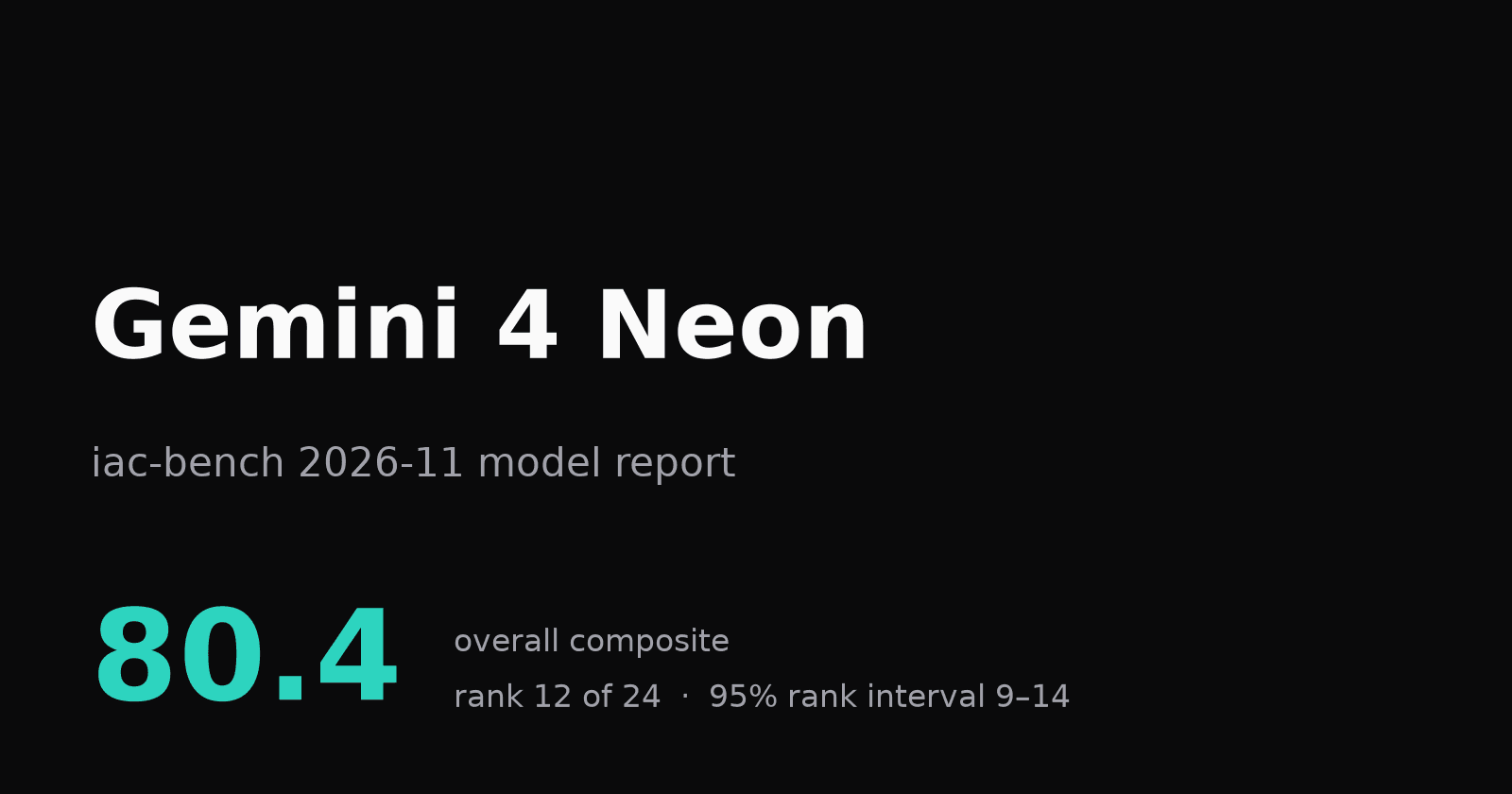
Gemini 4 Neon on iac-bench 2026-11
How Gemini 4 Neon did on iac-bench 2026-11: an overall composite of 80.4, scores per fixture, strengths, weaknesses and the patterns in its OpenTofu modules.
Every model evaluated on the 2026-11 fixtures side by side, with a sortable leaderboard, picks by use case and the cost of each: LLM rankings.
| Developer | |
| API identifier | gemini-4-neon |
| Access | Gemini API |
| Weights | Closed |
| List price (USD / M tokens, in / out) | 3.0 / 15.0 (OpenRouter, 2026-11-24) |
| Evaluated | 2026-11-23 (generation) · 2026-11-24 (judge) |
| Attempts | 18 (6 fixtures × 3 samples) |
| Overall composite | 80.4 (95% CI 79.3–82.3) |
| Rank | 12 of 24 (95% rank interval 9–14) |
| Mechanical only / judge only | 79.9 (rank 12) / 88.6 (rank 11) |
| Failed gates · insecure attempts | 0/18 · 0/18 |
| Estimated cost, all 18 attempts | $26.55 |
Summary
Gemini 4 Neon ranks 12th of 24 with an overall composite of 80.4, the highest of the six Google models. It is one of nine models with no security finding in any of its 18 attempts, and the only Google model among them. Its gap to Kimi K3.1 Pro (81.1, one place above) is within the margin of three samples (win probability 0.28). It is ahead of Gemini 4 Carbon, Qwen4 Max and Gemini 4 Hydrogen with win probabilities 0.97, 0.89 and 0.96.
On five fixtures its medians are 83.1–89.8, and its best attempt (App Service) scores 96.1. G004 is the exception at 43.5: all three Aurora modules have Secrets Manager manage the master password on member clusters of the global database, a known apply failure that halves the composite. Without the multiplier those three attempts would score about 82–89.
Its modules hardcode the security posture and include almost every expertise item the benchmark checks. Their weakness is size: a concept input such as a workload profile, plus an override input for each value it sets, gives it the largest interfaces in the field on three fixtures, and the interface budget is lost in 16/18 attempts.
Scores
| Fixture | Composite median (range) | Rubric median | Expertise | Judge median | ✗ gate | ⚠ security | Median inputs | Median output tokens | Median time | Median cost |
|---|---|---|---|---|---|---|---|---|---|---|
| G001 · S3 | 83.1 (81.3–85.5) | 0.802 | 7/7 | 86.8 | 0/3 | 0/3 | 34 | 42,253 | 791 s | $1.202 |
| G002 · Cloud SQL | 89.2 (88.2–89.2) | 0.832 | 9/9 | 100.0 | 0/3 | 0/3 | 32 | 46,016 | 644 s | $1.346 |
| G003 · App Service | 89.2 (87.8–96.1) | 0.899 | 5/5 | 86.8 | 0/3 | 0/3 | 17 | 61,714 | 860 s | $1.691 |
| G004 · Aurora global | 43.5 (41.2–44.5) | 0.423 | 7/8 | 86.8 | 0/3 | 0/3 | 48 | 61,916 | 1055 s | $1.824 |
| G005 · GKE | 89.8 (86.5–92.9) | 0.906 | 8/10 | 89.5 | 0/3 | 0/3 | 37 | 60,555 | 1007 s | $1.566 |
| G006 · Storage | 88.0 (87.2–89.5) | 0.920 | 6/8 | 81.6 | 0/3 | 0/3 | 25 | 36,399 | 708 s | $0.955 |
Rubric items not at full credit, counted over attempts that planned: G001: H12 3/3, H13 1/3, H15 3/3, A4 3/3, A5 3/3, B1 2/3; G002: H3 3/3, H9 3/3, H11 2/3, A8 3/3, B1 3/3; G003: H3 2/3, H7 1/3, A6 2/3, A7 1/3; G004: H9 3/3, H12 2/3, H17 1/3, A5 3/3, B1 2/3, known apply failure in 3/3 (score ×0.5); G005: H11 1/3, A5 3/3, B1 2/3; G006: A4 3/3. Definitions are in Scoring criteria.
Strengths
- No security finding in 18/18 attempts.
- App Service: HTTPS-only and disabled basic-auth publishing are literals on the app and
the slot (
H1andH2at full credit in 3/3). - Storage account: blob public access and shared-key access are off with no input to turn
them on (G006
H1,H2in 3/3). - GKE: nodes have no public IP and no input can give them one (G005
H2, 3/3).
- App Service: HTTPS-only and disabled basic-auth publishing are literals on the app and
the slot (
- Expertise items nearly complete.
- 7/7 on S3 and 9/9 on Cloud SQL in every attempt. That includes backups that survive
instance deletion (G002
E1), found in 6 of 71 field attempts; three of them are Gemini 4 Neon's. - 5/5 on App Service in 3/3, including Key Vault references (
E5, 16/72 field-wide). - One Aurora attempt finds all 8 G004 expertise items, including the engine version lookup and member versions that follow the global cluster.
- 7/7 on S3 and 9/9 on Cloud SQL in every attempt. That includes backups that survive
instance deletion (G002
- Cloud SQL graded 100 by the judge in 3/3. Consumer
database_flagsare merged before the module's security flags, so IAM authentication and audit logging cannot be turned off. - Validation everywhere. 17–35
validationblocks per module (449 across 18), plus preconditions such as refusingforce_destroyin production and rejecting wildcard CORS origins with write methods. - Clean mechanics. Lifecycle meta-arguments, Deprecated patterns, Outputs and Sensitive values scored 2 in 18/18; Internal logic, Scope and File layout in 17/18.
Weaknesses
- G004 known apply failure, 3/3.
manage_master_user_password = trueon member clusters (F1), so the composite is halved andH9is lost in 3/3. In two of them extra cluster parameters are merged after the defaults, so a consumer can overriderds.force_ssl(Anti-patterns 0). The same modules have 47–52 inputs against a budget of 12–22 (A5lost in 3/3), and two of three skip the final snapshot (H12). - Interface size. Budget items lost in 16/18 attempts: S3 33–41 inputs (budget 8–16), GKE 24–41 (11–21), storage account 20–32 (9–17), Cloud SQL 30–36 (25–35). The judge gave Interface design 1 in 13/18.
- Exposure knobs the judge flagged.
- GKE: one attempt's
enable_private_endpointandgcp_public_cidrs_access_enabledcan open the API server (Anti-patterns 0); another letssecurity_posture_modeandvulnerability_scanning_modebe set to disabled values; a third accepts0.0.0.0/0in an unvalidatedauthorized_networks. - Storage account: one attempt's
network_default_actionacceptsAllow, overriding the module's default-Deny firewall (Anti-patterns 0). - App Service:
minimum_tls_versionis an input in 2/3, losingH3.
- GKE: one attempt's
- S3 extras and gaps. CloudFront access grants in 3/3 (
A4); EventBridge notifications and bucket metrics judged out of scope in one attempt (Scope 1); no provider block with a configurable region (H15, 3/3); tags applied per resource rather than throughdefault_tags(H12half credit, 3/3). - Cloud SQL data protection.
H3at half credit in 3/3, nodeletion_policythat keeps removed databases in 2/3 (H11), and the region reaches the instance but not the provider (H9half credit, 3/3). - Provider constraints that admit a new major (
>= 6.0and similar) in 9/18 attempts (B1).
Characteristic patterns
- Profiles with overrides. On S3 every attempt adds a
workload_type,use_caseorworkload_profileinput, then a null-default override for each lifecycle value the profile sets (excerpt below). - The largest interfaces in the field on S3 (median 34), Aurora (48) and GKE (37), and the second largest on Cloud SQL (32). App Service is the exception at 17.
- Long outputs. 939,901 output tokens across 18 attempts, second only to GLM-5.3.
- Two inaccurate descriptions (Documentation 0 in 2/18): a GKE comment about
initial_node_count = 0replacing a deprecated flag, and an App Service resource group name that the code builds differently. - Leftover structure in one attempt. An Aurora module ships an empty
modules/regional-cluster/directory of nine empty files (File layout 1). - READMEs in 9/18 attempts, none on Cloud SQL or Aurora.
Representative excerpt
G001/gemini-4-neon-e3/locals.tf lines 73–78
  profile = local.workload_profiles[var.workload_profile]

  versioning_enabled                     = var.versioning_enabled != null ? var.versioning_enabled : local.profile.versioning_enabled
  object_expiration_days                 = var.object_expiration_days != null ? var.object_expiration_days : local.profile.object_expiration_days
  noncurrent_version_expiration_days     = var.noncurrent_version_expiration_days != null ? var.noncurrent_version_expiration_days : local.profile.noncurrent_version_expiration_days
  abort_incomplete_multipart_upload_days = var.abort_incomplete_multipart_upload_days != null ? var.abort_incomplete_multipart_upload_days : local.profile.abort_incomplete_multipart_upload_days
A workload profile chosen by one concept input sets the lifecycle defaults, and every value it sets also has its own override input. The profile suits app developers new to S3; the overrides are why its S3 modules have 33–41 inputs against a budget of 8–16.