New: LLM Rankings are live!
See how the top LLMs rank on real infrastructure tasks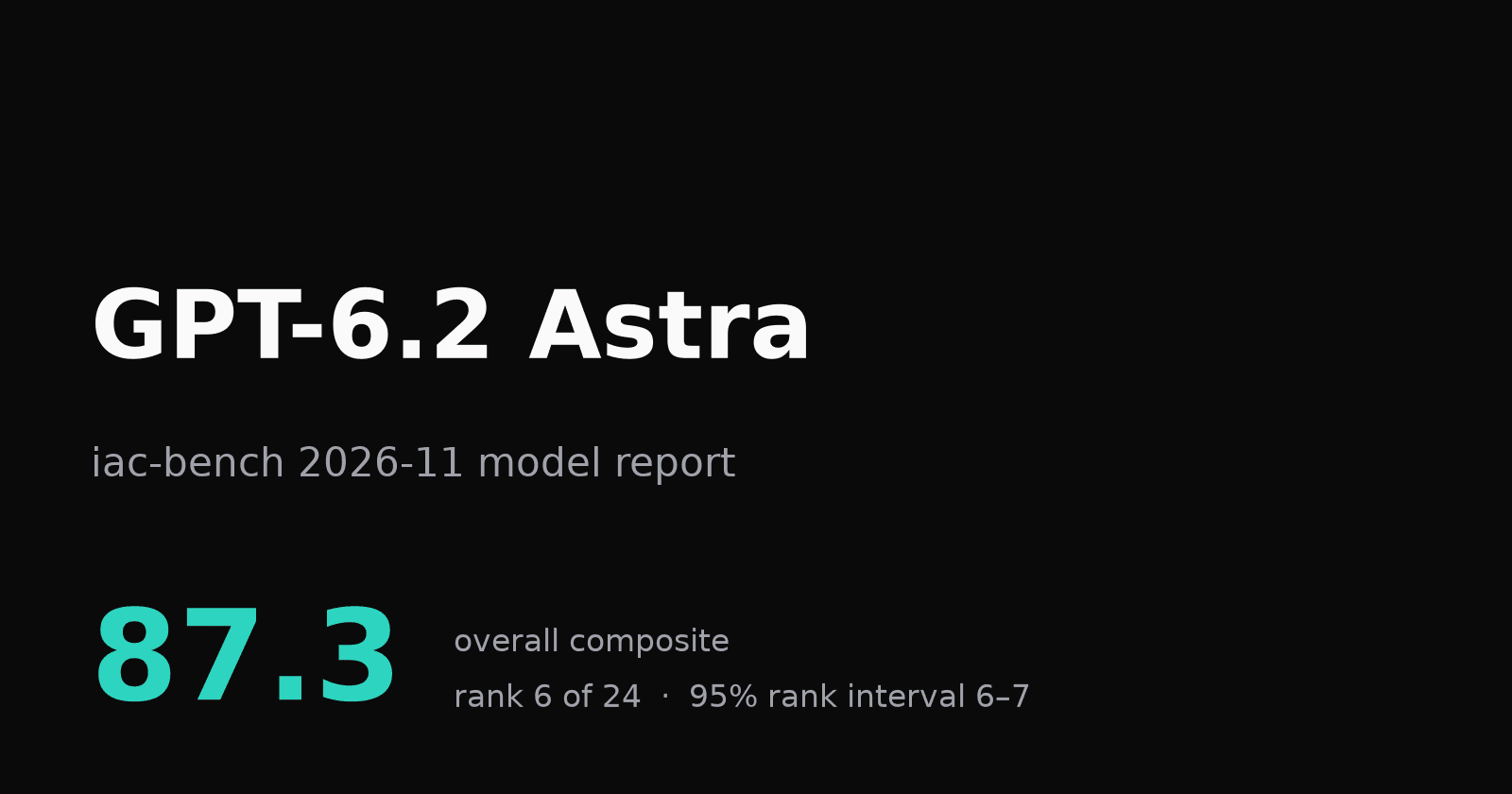
GPT-6.2 Astra on iac-bench 2026-11
How GPT-6.2 Astra did on iac-bench 2026-11: an overall composite of 87.3, scores per fixture, strengths, weaknesses and the patterns in its OpenTofu modules.
Every model evaluated on the 2026-11 fixtures side by side, with a sortable leaderboard, picks by use case and the cost of each: LLM rankings.
| Developer | OpenAI |
| API identifier | gpt-6.2-astra |
| Access | OpenAI API (Responses) |
| Weights | Closed |
| List price (USD / M tokens, in / out) | 8.0 / 40.0 (OpenRouter, 2026-11-24) |
| Evaluated | 2026-11-23 (generation) · 2026-11-24 (judge) |
| Attempts | 18 (6 fixtures × 3 samples) |
| Overall composite | 87.3 (95% CI 86.0–88.0) |
| Rank | 6 of 24 (95% rank interval 6–7) |
| Mechanical only / judge only | 84.1 (rank 7) / 95.2 (rank 3) |
| Failed gates · insecure attempts | 0/18 · 0/18 |
| Estimated cost, all 18 attempts | $4.48 |
Summary
GPT-6.2 Astra is new in 2026-11. It ranks sixth of 24 with an overall composite of 87.3 and a 95% rank interval of 6–7. It finishes ahead of GPT-6.1 Terra, the model just below it, in 82% of bootstrap resamples, so the two are within the margin of three samples. It is clearly separated from the models on either side of that pair: it essentially never finishes ahead of GPT-6.1 Sol or the four models above it, and essentially always ahead of Claude Haiku 5.5.
All 18 attempts planned, with no security findings and no known apply failure. Its best placings are the Aurora global database (G004, 88.1, fifth, with the third-highest rubric median) and App Service (G003, 93.7, sixth). S3 (G001, 78.0, 19th) and Cloud SQL (G002, 84.8, 18th) are its weakest. Its worst attempt scores 77.0, the fourth-highest worst case in the field.
The judge rates its short, opinionated modules more highly than the rubric does. Its judge-only score (95.2) ranks third and its mechanical-only score (84.1) seventh, the second-largest gap in the field after Claude Sonnet 5.5. Its judge medians run from 86.8 to 100 on every fixture; the rubric charges it for the inputs and operational features those modules leave out.
It is also the fastest and shortest writer in the field: a median of 98 seconds and 2,917 output tokens per attempt. All 18 attempts cost $4.48.
Changes since the 2026-10 report
GPT-6.2 Astra was not part of the 2026-10 release; this is its first report.
Scores
| Fixture | Composite median (range) | Rubric median | Expertise | Judge median | ✗ gate | ⚠ security | Median inputs | Median output tokens | Median time | Median cost |
|---|---|---|---|---|---|---|---|---|---|---|
| G001 · S3 | 78.0 (77.0–78.6) | 0.693 | 5/7 | 100.0 | 0/3 | 0/3 | 2 | 1,693 | 77 s | $0.112 |
| G002 · Cloud SQL | 84.8 (84.8–86.4) | 0.836 | 4/9 | 94.7 | 0/3 | 0/3 | 14 | 2,906 | 83 s | $0.190 |
| G003 · App Service | 93.7 (92.2–93.7) | 0.977 | 4/5 | 86.8 | 0/3 | 0/3 | 12 | 5,255 | 225 s | $0.329 |
| G004 · Aurora global | 88.1 (86.0–88.1) | 0.890 | 3/8 | 92.1 | 0/3 | 0/3 | 11 | 6,970 | 282 s | $0.473 |
| G005 · GKE | 90.3 (87.6–92.2) | 0.906 | 4/10 | 97.4 | 0/3 | 0/3 | 7 | 2,928 | 81 s | $0.192 |
| G006 · Storage | 89.0 (84.8–90.9) | 0.870 | 4/8 | 100.0 | 0/3 | 0/3 | 2 | 2,429 | 105 s | $0.188 |
Rubric items not at full credit, counted over attempts that planned: G001: H6 3/3, H7 3/3, H9 3/3, H12 3/3, H13 3/3, H14 3/3, H15 3/3, B1 3/3; G002: H4 3/3, H5 3/3, H8 3/3, H9 3/3, H11 3/3, A4 1/3, B1 3/3, B2 2/3; G003: B2 3/3; G004: H9 3/3, H11 3/3, H12 3/3, A7 3/3, A8 3/3, B1 3/3, B2 3/3; G005: H7 2/3, H9 3/3, H11 1/3, A4 3/3, A7 1/3, B1 3/3, B2 1/3; G006: H5 1/3, H7 3/3, H8 2/3, H9 1/3, A1 2/3, A5 3/3, A6 3/3. Definitions are in Scoring criteria.
Strengths
- Very small interfaces. Median inputs are 2 on S3 and on the storage account (G006), 7 on GKE (G005), 11 on G004, 12 on App Service (G003) and 14 on Cloud SQL (G002). Every storage-account attempt asks only for the resource group and the application's principal, and derives the account name and location itself (E4, E7, 3/3).
- Security fixed in code in all 18 attempts. On S3 it enforces bucket-owner ownership and a TLS-deny policy (E1, E4, 3/3); on the storage account, shared keys and nested public access are off and the portal defaults to Entra ID (E2, 3/3).
- App Service near the top of the rubric. Rubric median 0.977, tied fourth in the field, with
managed-identity image pulls and a metric alert in 3/3 (E3, E4). Its only rubric loss on
App Service is missing output descriptions (G003
B2). - An Aurora global database that deploys (3/3). Each region's cluster is declared in a
local child module (
regional/) that the root calls once per region (excerpt below). The module creates a KMS key in its own region, setsstorage_encrypted = true, and attaches a parameter group withrds.force_ssl = "1", so neither known apply failure occurs. No attempt setsmanage_master_user_password. Two generate the master password withrandom_passwordand keep a copy in a Secrets Manager secret (G004H9at 0.5, since the password lands in state); G004 e1 passes an ephemeral input to the write-onlymaster_password_wo, which G004H9scores as a raw input. Rubric median 0.890, third in the field; judge median 92.1, tied second. - Judged clean on the doctrine's structural sections. Internal logic, Scope, Inline Resource Configuration, Sensitive values, Lifecycle meta-arguments and the anti-pattern sections are 2 in all 54 readings.
Weaknesses
- G004 settings with no inputs (3/3). Deletion protection and the final snapshot are
hardcoded (G004
H11/H12at 0.75), and instance count (two per region) and backup retention (35 days) have no inputs (G004A7,A8). No attempt loads pgaudit, logs connections or enables enhanced monitoring (E1, E2, E4, 0/3). - Minimal S3 buckets. The only lifecycle rule aborts incomplete multipart uploads, so
transition, expiration and noncurrent-version rules are missing (G001
H6,H7, 3/3), and no attempt offers access logging (G001H9,H13), a region input (G001H15) or a way to setforce_destroy(G001H14), all 3/3. GPT-6 Astra, GPT-6 Luna and GPT-6.1 Terra lose the same lifecycle and logging items. - Cloud SQL gaps (3/3). No
deletion_policyon databases (G002H11), backups and point-in-time recovery always on (G002H4/H5at 0.75), no labels input (G002H8), the region fed to the instance rather than the provider (G002H9at 0.5), and nocloudsql.instanceUsergrant for the IAM users it creates (E6, 0/3). - Storage account inputs too few to cover the application. No attempt takes the
application's containers (G006
A6) or tags (G006A5), two cannot influence the account name (G006A1), two hardcodeLRS(G006H8), and none offers blob access logs (G006H7). - GKE without CMEK, labels or connection outputs. No attempt accepts a Cloud KMS key for
Secrets (G005
H9) or a labels input (G005A4), two set no maintenance window (G005H7), and the judge noted in every attempt that the outputs omit the cluster endpoint and CA certificate. - Provider constraints that admit a new major in 12 of 18 attempts (
B1):>= 5.0, < 7.0on S3,>= 6.0, < 8.0on Cloud SQL and GKE. On G004 the child module declareshashicorp/awswith no version constraint in all three attempts. - Missing descriptions on Cloud SQL (2/3), App Service (3/3), G004 (3/3) and GKE (1/3)
(
B2). The judge gave Documentation 1 in every App Service and G004 reading.
Characteristic patterns
- Single-file modules. G001 e3 and G006 e3 put the terraform block, variables, resources
and outputs in one
main.tf(File layout 0); several others keep outputs inmain.tf. File layout is its lowest judged section (27 of 54 readings at 2). - Hardcoded decisions instead of inputs, such as LRS or ZRS redundancy, two instances per region and 35-day backups on G004, and always-on Cloud SQL backups. The judge reads these as settled decisions (Interface design 2 in 53 of 54 readings); the rubric charges for the exposure and opt-out items they remove.
- Registry identity passed twice on App Service. Every attempt takes an ACR resource ID beside a registry URL or a client ID that could be looked up (Data sources vs inputs 1 in all nine readings), and the image regex rejects digest references in two attempts.
Representative excerpt
G004/gpt-6.2-astra-e1/regional/main.tf lines 84–99
resource "aws_rds_cluster" "db" {
  cluster_identifier                  = var.name
  engine                              = "aurora-postgresql"
  engine_version                      = var.engine_version
  global_cluster_identifier           = var.global_id
  source_region                       = var.source_region
  database_name                       = var.source_region == null ? var.database : null
  master_username                     = var.source_region == null ? "clusteradmin" : null
  master_password_wo                  = var.password
  master_password_wo_version          = var.password_version
  port                                = 5432
  db_subnet_group_name                = aws_db_subnet_group.db.name
  vpc_security_group_ids              = [aws_security_group.db.id]
  db_cluster_parameter_group_name     = aws_rds_cluster_parameter_group.pg.name
  storage_encrypted                   = true
  kms_key_id                          = aws_kms_key.db.arn
Each region's Aurora cluster is declared in a local child module, called once per region from the root. The cluster takes a write-only master password, encrypts its storage with a KMS key created in the same region and names a parameter group that sets rds.force_ssl. All three G004 attempts use this structure.