New: LLM Rankings are live!
See how the top LLMs rank on real infrastructure tasks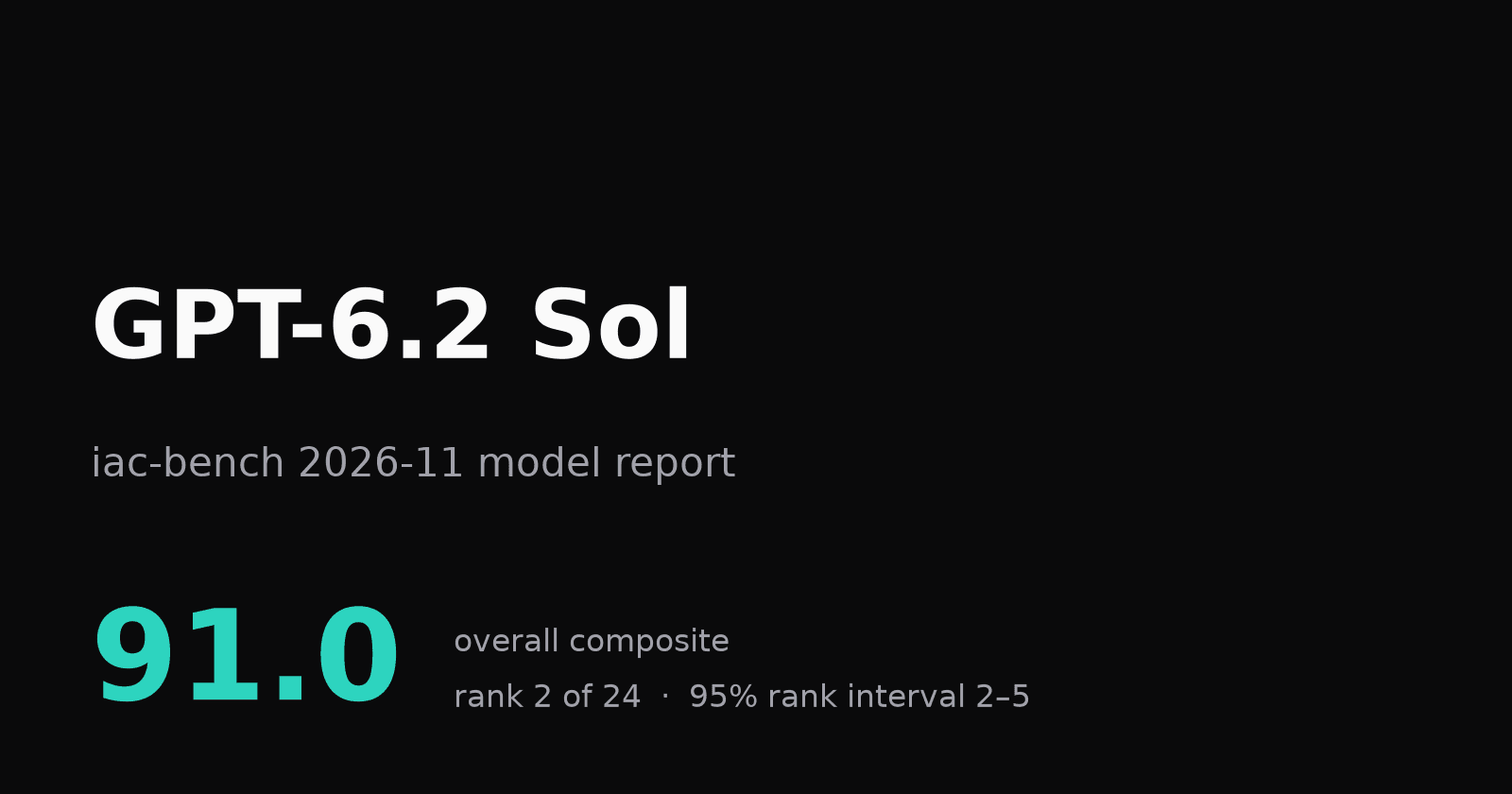
GPT-6.2 Sol on iac-bench 2026-11
How GPT-6.2 Sol did on iac-bench 2026-11: an overall composite of 91.0, scores per fixture, strengths, weaknesses and the patterns in its OpenTofu modules.
Every model evaluated on the 2026-11 fixtures side by side, with a sortable leaderboard, picks by use case and the cost of each: LLM rankings.
| Developer | OpenAI |
| API identifier | gpt-6.2-sol |
| Access | OpenAI API (Responses) |
| Weights | Closed |
| List price (USD / M tokens, in / out) | 2.0 / 10.0 (OpenRouter, 2026-11-24) |
| Evaluated | 2026-11-23 (generation) · 2026-11-24 (judge) |
| Attempts | 18 (6 fixtures × 3 samples) |
| Overall composite | 91.0 (95% CI 90.1–92.4) |
| Rank | 2 of 24 (95% rank interval 2–5) |
| Mechanical only / judge only | 89.1 (rank 3) / 95.6 (rank 2) |
| Failed gates · insecure attempts | 0/18 · 0/18 |
| Estimated cost, all 18 attempts | $3.00 |
Summary
GPT-6.2 Sol, new in 2026-11, ranks second of 24 overall (91.0), 3.7 points behind Claude Fable 5.2. Its lead over Claude Opus 5.5 (90.9) is not resolved: the bootstrap slightly favors Claude Opus 5.5, with a win probability for GPT-6.2 Sol of 0.43, and the two rank intervals (2–5 and 2–4) overlap. Against GPT-6 Astra (89.9) and GPT-6.1 Sol (89.5) its win probabilities are 0.87 and 0.80, and against Claude Fable 5.2 0.0. All 18 modules planned, and none failed a mandatory security item or matched a known apply failure. Its weakest attempt (84.5) is the second strongest worst case in the field, after Claude Fable 5.2's (90.3).
Its modules are small and decided. It never lost an interface-budget item in 18 attempts (only GPT-6.2 Astra shares that), and its median input counts (5, 14, 16, 11, 9 and 6 on the six fixtures) are among the lowest in the field. It is joint second on App Service (96.9, with GPT-6 Astra) and second on the Aurora global database (92.1), where the field median is 42.1. What it leaves out is service expertise: 83 of 141 expertise checks across its attempts, against 134 for Claude Fable 5.2 and 121 for Claude Opus 5.5. At $3.00 for all 18 attempts, it costs less than half of Claude Opus 5.5 ($7.12) and about a fifteenth of Claude Fable 5.2 ($44.52).
Scores
| Fixture | Composite median (range) | Rubric median | Expertise | Judge median | ✗ gate | ⚠ security | Median inputs | Median output tokens | Median time | Median cost |
|---|---|---|---|---|---|---|---|---|---|---|
| G001 · S3 | 87.0 (84.5–87.0) | 0.832 | 4/7 | 100.0 | 0/3 | 0/3 | 5 | 5,211 | 157 s | $0.081 |
| G002 · Cloud SQL | 88.2 (85.2–90.1) | 0.846 | 6/9 | 100.0 | 0/3 | 0/3 | 14 | 8,281 | 164 s | $0.125 |
| G003 · App Service | 96.9 (96.9–98.5) | 1.000 | 4/5 | 92.1 | 0/3 | 0/3 | 16 | 12,348 | 376 s | $0.195 |
| G004 · Aurora global | 92.1 (90.8–92.5) | 0.930 | 4/8 | 92.1 | 0/3 | 0/3 | 11 | 22,076 | 592 s | $0.374 |
| G005 · GKE | 93.1 (92.6–94.5) | 0.942 | 5/10 | 97.4 | 0/3 | 0/3 | 9 | 8,710 | 158 s | $0.131 |
| G006 · Storage | 88.5 (87.6–94.2) | 0.900 | 5/8 | 92.1 | 0/3 | 0/3 | 6 | 6,508 | 217 s | $0.113 |
Rubric items not at full credit, counted over attempts that planned: G001: H7 1/3, H9 2/3, H12 3/3, H13 3/3, H14 3/3, H15 1/3, B1 3/3; G002: H3 2/3, H4 3/3, H5 3/3, H9 3/3, H11 3/3, A5 1/3, B1 3/3; G004: H11 3/3, H12 3/3, H16 1/3, A1 1/3, A3 1/3, A7 3/3, A8 3/3, B2 2/3; G005: H9 2/3, A4 1/3, B1 3/3; G006: H7 3/3, H9 2/3, A1 3/3. Definitions are in Scoring criteria.
Strengths
- An Aurora master password that never reaches state. In 3/3 G004 attempts the
password is generated as an ephemeral value, written to Secrets Manager through
write-only arguments, read back ephemerally and passed to the primary cluster as
master_password_wo(excerpt below). It is the only model with full credit on G004H9in every attempt (Claude Fable 5.2 has 2/3), and none of its G004 attempts matches a known apply failure. Its default engine versions (16.9–16.11) all support global databases (G004H17, 3/3). - App Service at full rubric credit in 3/3, the only model to do so on any fixture. HTTPS-only, disabled basic-auth publishing and TLS 1.2 are set on the app and the slot, with 11–16 inputs against a budget of 20. Its worst G003 attempt (96.9) is the best worst case on that fixture.
- Small interfaces with the decisions made. Typed object inputs (
capacity,container,regions,backup) keep related settings together, and settings the audience should not tune are literals: on G004, 35-day backup retention and a fixed instance count per region; on the storage account, shared keys, nested public access and cross-tenant replication off. - The judge rated its design highly: median 100 on S3 and Cloud SQL, 97.4 on GKE, and a judge-only score of 95.6, second in the field.
Weaknesses
- Expertise left out. Median expertise is 4/7 on S3 (no Intelligent-Tiering, name uniqueness or consumer access policies), 6/9 on Cloud SQL (no backups surviving deletion, customer-managed key or Query Insights), 4/8 on Aurora (no pgaudit, enhanced monitoring or engine-version lookup) and 5/10 on GKE.
- Protection with no way out. Deletion protection is hardcoded on Cloud SQL in 2/3
attempts (G002
H3at zero) and on Aurora in 3/3 (G004H11at 0.75). Aurora final snapshots have no opt-out (G004H12at 0.75, 3/3). Two G004 attempts also addprevent_destroy, to the clusters and keys in one and to the KMS keys in the other, which the judge marked down under Lifecycle meta-arguments. - Settings a service cannot choose. Because backup retention and instance count are
fixed on G004,
A7andA8are lost in 3/3. - Gaps on S3 and the storage account.
- S3: no access logging in 2/3 (G001
H9), a log destination that cannot deliver where it is offered (H13), andforce_destroyhardcoded with no input (H14, 3/3). - Storage account: no blob access logs (G006
H7, 3/3), no lifecycle policy in 2/3 (H9), and no input that influences the account name (A1, 3/3): one attempt names it from a hash of the resource group's ID.
- S3: no access logging in 2/3 (G001
- Provider constraints spanning two majors (
>= 5.0, < 7.0on AWS,>= 6.0, < 8.0on Google) in 9/18 attempts (B1), every attempt on S3, Cloud SQL and GKE. No Cloud SQL attempt sets the provider's region from an input (G002H9at half credit, 3/3).
Characteristic patterns
- A README in 18/18 attempts and short files.
main.tfpasses 200 lines in 1/18 attempts. On G004 it splits by concern (database.tf,encryption.tf,network.tf,monitoring.tf). - It derives from what already exists. The storage account reads its location from the
resource group, and on G004 the subnets come from
environmentand thetier = databasetag. - A paired registry input on App Service. All three G003 attempts ask for both a registry ID and its login server rather than looking the server up, which the judge marked down under Data sources vs inputs in 3/3.
Representative excerpt
G004/gpt-6.2-sol-e2/encryption.tf lines 84–99
ephemeral "random_password" "bootstrap" {
  length  = 40
  special = false
}

resource "aws_secretsmanager_secret_version" "bootstrap" {
  secret_id                = aws_secretsmanager_secret.admin.id
  secret_string_wo         = jsonencode({ username = local.admin_user, password = ephemeral.random_password.bootstrap.result })
  secret_string_wo_version = 1
}

ephemeral "aws_secretsmanager_secret_version" "admin" {
  secret_id     = aws_secretsmanager_secret.admin.id
  version_stage = "AWSCURRENT"
  depends_on    = [aws_secretsmanager_secret_version.bootstrap]
}
The master password is generated as an ephemeral value, written to Secrets Manager through a write-only argument and read back ephemerally for the cluster's master_password_wo, so it never appears in plan or state and Secrets Manager does not manage it on a global member. All three of its G004 attempts follow this pattern.